

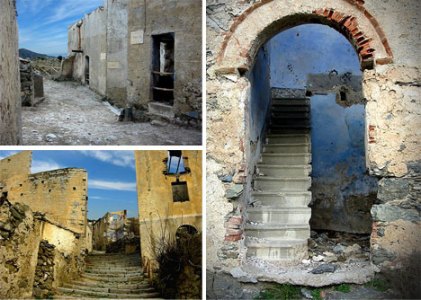
Abandoned Mountain Town of Sardinia, Italy
Little is available online about this picturesque deserted mountain, mountain with brightly painted doors and largely intact structures. Know more?
Feel free to discuss and link in the comments!
Sardinia – De Wikipedia
Sardinia (pronounced /sɑrˈdɪniə/; Italian: Sardegna, [sarˈdeɲɲa]; Sardinian: Sardigna or Sardinnya [sarˈdinja]) is the second-largestisland in the Mediterranean Sea (after Sicily and before Cyprus). It is an autonomous region of Italy, and the nearest land masses are (clockwise from north) the French island of Corsica, the Italian Peninsula, Sicily, Tunisia and the Spanish Balearic Islands.
The name Sardinia is from the pre-Roman noun *sard[ ], romanised as sardus (feminine sarda); that the name had a religious connotation is suggested from its use also as the adjective for the ancient Sardinian mythological hero-god Sardus Pater «Sardinian Father» (misunderstood by many modern Sardinians/Italians as being «Father Sardus»), as well as being the stem of the adjective «sardonic«. Sardinia was called Ichnusa, the Latinised form of the Greek Hyknusa, Sandalion, Sardinia and Sardo by the ancient Greeks and the Romans.
Ogliastra hinterland – abandoned towns and ancient towers
On friday the 28th the sea was livelier than we wanted to be part of, and we decided on an excursion by car to the mountains in the Ogliastra hinterland.
First we drove to Jerzu which is a bit further inland from Cardedu, where the mountains really begins. Francesco drove up some of the steepest and most curved roads I have ever been on, up to what is called the “Tacchi di Ogliastra”, meaning the high heels of Ogliastra. They are a series of mountains where the top is surrounded by vertical rock walls of maybe 100-200m. The mountains in Sardinia aren’t high by Himalayan standards, the tallest peaks are just over 1800m, but they’re still impressive in all their ruggedness.
The many vertical rock walls are a little paradise for climbers, who come from all over to play in the Sardinian mountains.
One of the two large islands that lie of the western (Mediterranean) coast of Italy, Sardinia is much less explored and far emptier than its southern neighbour Sicily. Marooned between Italy and north Africa, it lies some 200km off the coast of Lazio. At its northern tip it gazes just a few miles across the water to the French island of Corsica. DH Lawrence visited in the early 1920s and found it ‘lost between Europe and Africa and belonging to nowhere’.
SARDINIA HISTORY
Perhaps the geographical confusion is accentuated by the number of times Sardinia has been invaded over the past two millennia. The island has certainly been inhabited since prehistoric times. You don’t have to dig to find this; the evidence is all over Sardinia in the shape of the bizarre nuraghi, conical stone buildings, rather like beehives. They were mainly constructed between 1500BC and 500BC, apparently as defensive structures as well as homes. This ancient culture was at its height around 1000 years before the birth of Christ … the fact that 700 of the nuraghi survive 3000 years later gives an indication of their power.
But as the civilisations around the Mediterranean gained bigger, faster ships, so islands such as Sardinia became targets for invasion. Around the eighth century BC, the Nuraghi were trading with the Phoenicians, but around 600BC they were invaded by Carthage, who made the short hop from North Africa. The Romans came next of course, and the Sard people were all but wiped out in a bloody campaign in 176BC, when 25,000 islanders were slaughtered.

 Arquitectonico
Debe estar conectado para enviar un comentario.