

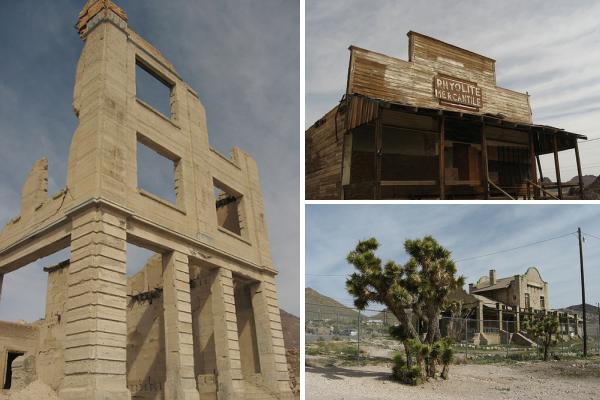
To date Urban Ghosts Media has explored a number of ghost towns, from Bodie, the quintessential Wild West frontier town, to some of the world’s most fascinating abandoned towns and cities. But what more appropriate location for a ghost town than the aptly named Death Valley? That’s where the remains of Rhyolite stand, and even today the ruins tell of a prosperous and relatively grand settlement.
Located in Nevada’s Bullfrog Hills about 120 miles northwest of Las Vegas, Rhyolite emerged as one of several mining camps in 1905 and exploded after the large scale discovery of gold. In the spirit of the Wild West, the ensuing gold rush brought miners, gold diggers and adventurers, bound by the promise of financial gain. Accompanying them were enterprising service providers intent on making a living off the rewards reaped through the burgeoning industry.
Read more:
http://www.urbanghostsmedia.com/2010/10/rhyolite-death-valleys-haunting-ghost-town/#ixzz12AkLrMjH
vía Rhyolite: Death Valley‘s Haunting Ghost Town |.
Rhyolite, Nevada – Wikipedia, the free encyclopedia
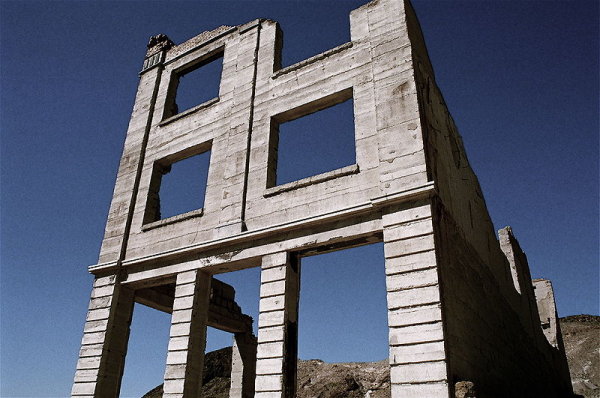
Rhyolite is a ghost town in Nye County, in the U.S. state of Nevada. It is located in the Bullfrog Hills, about 120 miles (190 km) northwest of Las Vegas, near the eastern edge of Death Valley. The town began in early 1905 as one of several mining camps that sprang up after a prospecting discovery in the surrounding hills. During an ensuing gold rush, thousands of gold-seekers, developers, miners, and service providers flocked to the Bullfrog Mining District. Many settled in Rhyolite, which lay in a sheltered desert basin near the region’s biggest producer, the Montgomery Shoshone Mine.
Industrialist Charles M. Schwab bought the Montgomery Shoshone Mine in 1906 and invested heavily in infrastructure including piped water, electric lines, and railroad transportation that served the town as well as the mine. By 1907, Rhyolite had electric lights, water mains, telephones, newspapers, a hospital, a school, an opera house, and a stock exchange. Published estimates of the town’s peak population vary widely, but scholarly sources generally place it in a range between 3,500 and 5,000 in 1907–08.
Rhyolite declined almost as rapidly as it rose. After the richest ore was exhausted, production fell. The 1906 San Francisco earthquake and the financial panic of 1907 made it more difficult to raise development capital. In 1908, investors in the Montgomery Shoshone Mine, concerned that it was overvalued, ordered an independent study. When the study’s findings proved unfavorable, the company’s stock value crashed, further restricting funding. By the end of 1910, the mine was operating at a loss, and it closed in 1911. By this time, many out-of-work miners had moved elsewhere, and Rhyolite‘s population dropped well below 1,000. By 1920, it was close to zero.

 Arquitectonico
Debe estar conectado para enviar un comentario.