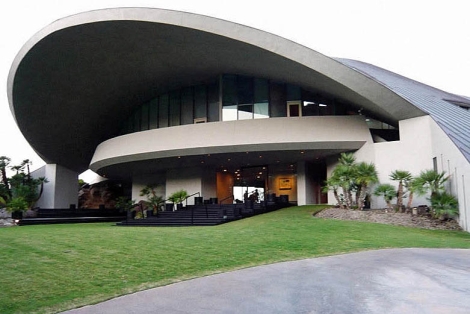

La casa con forma de volcán de Bob Hope, a la venta por 38,4 millones | Vivienda | elmundo.es


EEUU | En California

  • Fue diseñada en 1979  por el arquitecto John Lautner, coautor de la casa ‘Chemosphere

Entrada de la casa | Trianglemodernisthouses.com - ElMundo.es

El cómico Bob Hope (1903-2003) vivió los últimos 25 años de su vida en una marciana vivienda con una gigantesca cúpula con forma de volcán que se hizo construir a orillas del Lago Toluca, en la lujosa zona residencial de Palm Springs (California).

Ha sido a raíz de la muerte de su esposa, Dolores LaFina, en 2011, cuando las inmobiliarias californianas Patrick Stewart y Ann Eyesenring han puesto a la venta el patrimonio inmobiliario del actor, estrella de Hollywood y la televisión desde los años 30, conocido por las arengas que dedicó a los soldados estadounidenses en Vietnam.

La vivienda fue diseñada en 1979 para el cómico y su mujer por John Lautner, coautor de una de las residencias más singulares de Estados unidos, la casa ‘Malin-Chemosphere’, de la familia Taschen.

vía La casa con forma de volcán de Bob Hope, a la venta por 38,4 millones | Vivienda | elmundo.es.

Googie Architecture: Futurism Through Modernism


Art & Design

By Greg LeMaire

At the peak of the modern era, a meshing of car culture and the Space Age brought about the gaudy and garnished Googie architecture. The signatures Googie style lie in sweeping arches and hard angles, cantilevered roofs and bold colors, and, its most relative homage to the Space Age, the starburst. The first of the Googie style, and its namesake, was a coffee shop designed by architect John Lautner by the name of “Googies”. With its place on Sunset Boulevard in Los Angeles the new style caught the eye of many passersby who began to associate the style with the glamour of Hollywood. The spread of this movement from Southern California went most notably north and south along the shore to become a symbol of west coast futurism.

Union 76 Gas Station, Beverly Hills
Photo by http://www.flickr.com/photos/markvanslyke/

The main settings for the Googie style were harbored in the roots of its founding. Coffee shops, gas stations and fast food venues used this architecture as much as a marketing campaign as for structural support. A Googie building was a symbol that a business was with the times, which in turn brought traffic and attention to its doors. The McDonalds of the 1950s and 60s famously adopted Googie style. The two fit hand in hand. The signature arches could be said to be of both houses and the fast growing company was in need of a symbol of the times and here it was found. The scene of a wing tipped cruiser parked in front of the 1950s McDonalds still holds strong as an icon of the era.

vía Googie Architecture: Futurism Through Modernism.

acampaSol_2011_005_DSCN0377
Foto por Darío Alvarez, Mayo 2001 http://www.flickr.com/photos/darioalvarez

Googie Architecture Online

Googie was the exaggerated Modern architecture seen in the coffee shops and bowling alleys of the 1950s and 1960s.

* – * – * – * – *
La noticia de hoy en ArquitecturaS (vía Twitter@arquitectonico

https://twitter.com/#!/arquitectonico/status/112120809945968640

Diseña un sitio como este con WordPress.com
Comenzar