
Deserted Walled Medieval Town of Craco, Italy (Sitios fantasma XIII) – 24 Tales of Ghost Towns and Abandoned Cities – WebUrbanist


Foto:  WebUrbanist
Foto: WebUrbanist

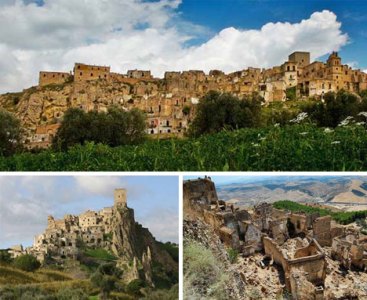
Deserted Walled Medieval Town of Craco, Italy

Like This!

The deserted walled medieval town of Craco had a village located on its site as far back as the 500s AD. Over time, however, it was plagued by, well, plagues … as well as agricultural droughts, rogue banditry and finally insurmountable seismic activity which threatened to bring the whole town down. In the 1960s the last of the residents were evacuated for fear of an earthquake that could level the entire site and the town has since sat entirely abandoned high up on a 400-foot cliff.

vía 24 Tales of Ghost Towns and Abandoned Cities Deserted Walled Medieval Town of Craco, Italy – WebUrbanist.

Pueblos fantasma. Craco, ciudad medieval abandonada. En «Tejiendo el Mundo«

Craco

Paseando por las solitarias calles de este lugar, se pueden escuchar los ecos de miles de niños que corretearon por sus empinadas cuestas. Imaginar los pasos apresurados de las viejas que, al son de las campanas de la iglesia parroquial de San Nicola, acuden presurosas a la misa de doce.

Sin prisa y con el silbido de la brisa que siempre sopla en el valle de Cavone como único compañero, las destartaladas fachadas de palacios como el palazzo Grossi, el Madonna, el Carbone o el Simonetti van guiando el rumbo del caminante hacia las ruinas del viejo castillo. Fortaleza que durante muchísimos siglos acogió a las familias más poderosas del sur de Italia.
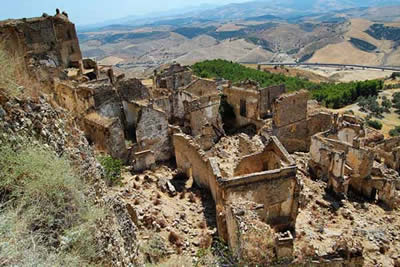
Craco, Italia. Foto: Petes Travel Snippets

CRACO (Italy): A Fascinating Medieval Town

Craco is located in the Region of Basilicata and the Province of Matera. About 25 miles inland from the Gulf of Taranto at the instep of the “boot” of Italy. This medieval town is typical of those in the area, built up with long undulating hills all around that allow for the farming of wheat and other crops. Craco can be dated back to 1060 when the land was in the ownership of Archbishop Arnaldo, Bishop of Tricarico. This long-standing relationshop with the Church had much influence over the inhabitants throughout the ages.

The solitude of ghost towns like Craco in Italy

From the hustle and bustle and the chaos to the silence and most absolute desolation: Once upon a time, cities that are now completely deserted use to be immersed in the everyday din of noisy life. A continuous flow of people and cars and the roar of civilization were witnesses of their essence till the day everything stopped. They were completely abandoned, left empty and silent.

ITALY, Craco: the ghost town ! skyscrapercity.com

Craco – De Wikipedia

Craco is a comune and medieval village located in the Region of Basilicata and the Province of Matera in Italy. About 25 miles inland from the Gulf of Taranto at the instep of the “boot” of Italy. The medieval village of Craco is typical of the hill towns of the region with mildly undulating shapes and the lands surrounding it sown with wheat.

Craco was built on a very steep summit, for defensive reasons, giving it a stark and striking appearance and distinguishing it from the surrounding lands which are characterized by soft shapes. The center, built on the highest side of the town, facing a ridge runs steeply to the southwest where newer buildings exist. The town sits atop a 400 meter high cliff that overlooks the Cavone River valley. Throughout the area are many unique vegetation-less mounds formed by intensive erosion that are called «calanchi.»

Abandoned Resort Town of Yashima, Japan (Sitios fantasma XII) – 24 Tales of Ghost Towns and Abandoned Cities – WebUrbanist


Imagen: Web Urbanist

Abandoned Resort Town of Yashima, Japan

Like This!

Yashima is a high and open plateau on one of the main islands of Japan. During peak economic years in the 1980s investors decided to create a resort village complete with a half-dozen hotels, curio shops and a rail line to the top of the peak of the city. When the economy fell on harder times and they could not bring in the tourist dollars the entire village was shut down, leaving many shops with eerie remnant collections of collectible tourist goodies and leaving furniture and other relics in the hotels and other support buildings.

vía 24 Tales of Ghost Towns and Abandoned Cities Abandoned Resort Town of Yashima, Japan – WebUrbanist.

Yashima

Located on Shikoku, one of the major islands of Japan, Yashima is an abandoned tourist resort that was supposed to draw tourists to the area. After all, this is one of the most important pilgrimage sites on Shikoku, with the Yashima Temple rising up at the top of the plateau. It’s also where a very important battle took place during the Genpei War, in 1185.

Yashima Junior High School - Foto: douglaspperkins (Flickr)

Unfortunately things didn’t quite go according to plan. The economy was surging during the 1980s and entrepreneurs around Takamatsu thought it would be a good idea to invest in tourism and capitalize on the area’s spiritual reputation. They built six hotels, many other theme parks and even an aquarium.

Business was good for a while, but, somewhere along the way people realized there wasn’t much to see in Yashima, so they stopped coming here. The resort’s hotels and gift-shops had to be shut down, and the investors, who had already lost millions of Yen, simply abandoned the project.

Many of the hotel rooms look untouched and some of the tourist shops have their merchandise carefully arranged, making it look like their owners had to leave in a hurry, thus adding to the place eeriness.

Abandoned Yashima

Yashima (or 屋島 which probably won’t display right) is an imposing plateau to the northeast of Takamatsu, the second largest city on Shikoku, one of Japan’s major islands.

ABANDONED YASHIMA RESORT: Shikoku In Japan

The Yashima hotel resort village in Shikoku was intended by investors to be a bustling place with several hotels, restaurants, shops, a rail line and probably more if it were continued.

It was originally build in the 1980’s alongside a popular temple that was seen as an attraction centerpiece to try and draw visitors in.

Deserted Floating City of Oily Rocks, Azerbaijan (Sitios fantasma XI) – 24 Tales of Ghost Towns and Abandoned Cities – WebUrbanist


Deserted Floating City of Oily Rocks. Foto: WebEcoist

Deserted Floating City of Oily Rocks, Azerbaijan

Like This!

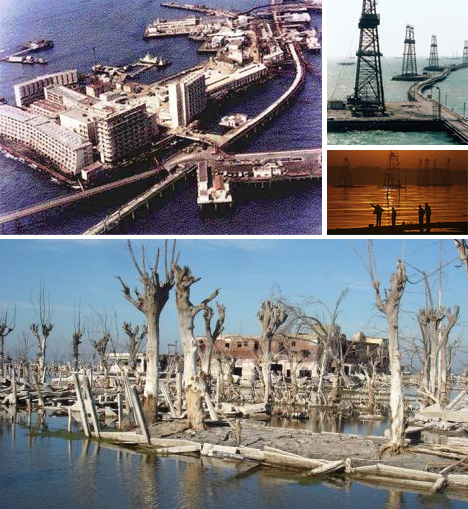
Off the coast of Azerbaijan sits what remains of one of the strangest organically-evolved cities in the world. Oily Rocks started with a single path out over the water, built on the backs of ships sunken to serve as foundations. This system of paths grew and evolve to serve the oil-drilling industry and eventually were widened to create space for houses, schools, libraries and shops for the workers and their families. Today, most of it sits abandoned and some paths and buildings have sunk back under the surf never to be seen again.

vía 24 Tales of Ghost Towns and Abandoned Cities Deserted Floating City of Oily Rocks, Azerbaijan – WebUrbanist.

Oily Rocks, Legend and Reality

by Seyyad Ibrahmov, Azerbaijan International

THE EARLY DAYS

A Soviet Stamp commemorating Oily Rocks, the first off-shore oil project in the world. Azerbaijan International.

It was the stuff of legends, that night of November 7, 1949. Out there on the trestles hovering over the depths of the sea, nobody could sleep that night. If their calculations were correct, it would be the historical night everyone had been waiting for, the culmination of years of work. There, off the coast of Azerbaijan, would mark the first time oil had been recovered from depths in the sea.

And just as predicted, it happened. Oil was struck at a depth of 1,100 meters beneath the Caspian. And when that black, thick fountain started to pour forth, no one could contain their excitement and exuberance. Everyone rushed to feel it, to put their hands in it and smear it all over their arms and faces, hugging each other and shouting for joy. Their hard work had finally proved successful.

A new name was coined that night: no longer would the place be known as «Black Rocks.» The source of the «black» that passing ships had noted even a hundred years earlier, had finally been confirmed. Henceforth, it would be called «Oily Rocks» (Neft Dashlari).

Members of that first expeditionary team often used to recall that night that took place nearly 50 years ago. The group was led by Aghagurban Aliyev, a geologist and Yusif Safarov, Deputy Head of the Exploration Drilling Trust, who was responsible for determining exactly where they should drill. Mikhail Kavyorochkin headed up the Exploration Drilling Trust.

The small town of «Neft Dashlari» (called also the «Oily Rocks» area) is situated along the Caspian sea, east of Baku and is the world’s first offshore oil field.)

Neft DaşlarıDe Wikipedia

Neft Daşları (also, Neftyanyye Kamni and Nerftekamni; in English, Oil Rocks) is a settlement in BakuAzerbaijan. The settlement forms part of the municipality of Çilov-Neft Daşları in Əzizbəyov raion.[2]

The Oil Rocks Drilling Platform is located in Neft Daşları. A full town on the sea, it was the first oil platform in Azerbaijan. It was built in 1947 as an exercise of Soviet and Azeri ambition. The Oil Rocks lies 45–50 km (28–31 mi) offshore on the Caspian Sea and extracts oil from the shallow water portion of the Absheron geological trend. The most distinctive feature of the Oil Rocks is that it is actually a functional city with a population of about 5,000 and over 200 km (120 mi) of streets built on piles of dirt and landfill. Most of the inhabitants work on shifts; a week on Oil Rocks followed by a week on the shore. The small city includes shops, school and a library. After almost 60 years the Oil Rocks is still quite unusual as Azerbaijan’s first and largest oil platform.

Oil Rocks (Neft Dashlari, Neftyanyye Kamni), oil city in the Caspian sea, Baku, Azerbaijan
| .Azerbaijan, Industrial Facility

The Rock of Ages

Once the pearl of Azerbaijan’s industry, the Oily Rocks rig teeters on the brink of ruin — even as the region ushers in a coming oil boom. Is there a future for the world’s oldest drilling platform, and for its workers?Marcel Theroux reports from the Caspian Sea.

By Marcel Theroux

Pennzoil Pays Dues at Oily Rocks

By Thomas de Waal

BAKU, Azerbaijan — The men from Pennzoil refuse to say they got burned in Azerbaijan, but they do concede that doing business there is a long haul.

«Business is not a sprint here, it’s a marathon,» said Paul Justice, Pennzoil’s vice president for public affairs.

The Houston-based company now has a 10 percent stake in the international consortium exploiting three Caspian Sea oil fields. But they have also been involved in a natural gas project that has run less smoothly. The project is now up and running, but Pennzoil has not yet been paid the $150 million it is owed for it.

Bookmark and Share

Abandoned Flooded City of Quabbin, Massachusetts (Sitios fantasma X) – 24 Tales of Ghost Towns and Abandoned Cities – WebUrbanist


Some nearby structures sit above the waterline but were abandoned without the adjacent buildings that sustained their use. WebUrbanist

Abandoned Flooded City of Quabbin, Massachusetts

Like This!

The Quabbin Reservoir is the now the largest body of water in Massachusetts. However, the area it now occupies once had four small towns and a network of roads and rail tracks running through it – all of which were flooded or displaced by the filling of the area with water. While some public structures, memorials and graves were moved out of the way many still sit today at the bottom of this body of water. Some nearby structures sit above the waterline but were abandoned without the adjacent buildings that sustained their use.

vía 24 Tales of Ghost Towns and Abandoned Cities Abandoned Flooded City of Quabbin, Massachusetts – WebUrbanist.

Quabbin Reservoir
From Wikipedia, the free encyclopedia

The Quabbin Reservoir is the largest inland body of water in the Commonwealth of Massachusetts and was built between 1930 and 1939. Today along with the Wachusett Reservoir, it is the primary water supply for Boston, some 65 miles to the east, as well as 40 other communities in Greater Boston. It also supplies water to three towns west of the reservoir and acts as backup supply for three others.[1] It has an aggregate capacity of 412 billion U.S. gallons (1.56 km³) and an area of 38.6 square miles (99.9 km²). Quabbin Reservoir water flows to the Wachusett Reservoir using the Quabbin Aqueduct. The Quabbin watershed is managed by the Massachusetts Department of Conservation and Recreation, while the water supply system is operated by the Massachusetts Water Resources Authority. The Winsor Dam and the Goodnough Dike form the reservoir from impoundments of the three branches of the Swift River. The Quabbin Reservoir is part of the Chicopee River Watershed.

Quabbin Reservoir - DCR, USA

Quabbin Reservoir

Quabbin Visitor Center 485 Ware Road (Rte. 9) Belchertown, MA 01007
413-323-7221

Quabbin Reservoir is one of the largest man-made public water supplies in the United States. Created in the 1930s by the construction of two huge earthen dams, the reservoir is fed by the three branches of the Swift River, and seasonally by the Ware River. Quabbin’s water covers 39 square miles, is 18 miles long and has 181 miles of shoreline. When full, Quabbin holds 412 billion gallons of water.

The New Salem and Enfield lookouts offer magnificent views of the reservoir. In order to flood the vast area of the Swift River Valley in the 1930s, the entire population of four towns had to be relocated. Hundreds of homes, businesses, a state highway, a railroad line, and 34 cemeteries were also moved or dismantled. Over 6,000 graves were relocated from the Valley to Quabbin Park cemetery.

Interpretive Services
The Quabbin Interpretive Services Program operates the Quabbin Visitor Center, Education Programs, Teacher Workshops, and provides general information about DCR resources. Three full time staff members are available to assist with visitor information and services. An automated telephone system – 413 323-7221 – provides 24 hour access to current information on fishing, hunting, programs, rules and regulations, and public access.

Quabbin Reservoir logging moratorium placed by Massachusetts Department of Conservation and Recreation

John Appleton, The Republican

BELCHERTOWN – A moratorium has been placed on commercial logging in the woods around Quabbin Reservoir, but about 29 loggers whose current contracts were put on hold will be able to resume work under the terms of their agreements with the state.

The Massachusetts Department of Conservation and Recreationannounced on Tuesday that it is starting a scientific review of its watershed forestry management program, which has included limited commercial logging for more than 50 years.

Bookmark and Share

Abandoned Medieval Town of Balestrino, Italy (Sitios fantasma IX) – 24 Tales of Ghost Towns and Abandoned Cities – WebUrbanist


Balestrino, Italy - listverse.com

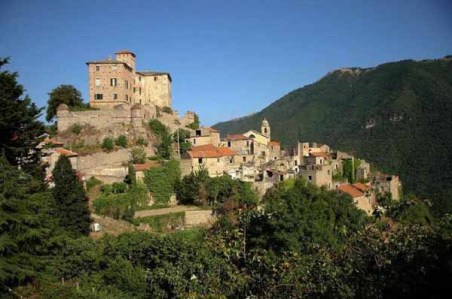
The origins and much of the history of this slow-built settlement in Tuscany remain unknown, constructed in pieces over many centuries. In the 1100s it was owned by the Benedictine abbey of San Pietro dei Monti. Today the beautiful small town-on-the-bluffs features a castle at the top and partially walled city sprawled on the olive-treed hillside around – but all are completely abandoned. Due to seismic instability the residents were moved out decades ago, leaving behind a perfectly preserved but piecemeal museum of modern and medieval history. Still, visit it soon: the next earthquake in the area may be the last this old town ever sees.

Like This!

vía 24 Tales of Ghost Towns and Abandoned Cities Abandoned Medieval Town of Balestrino, Italy – WebUrbanist.

Balestrino, Italy en listverse.com
Balestrino is quite a strange case in that it was extremely difficult to find any decent information on it. At least on the abandonment itself. No one is quite sure when the town was established, though records date back to before the eleventh century – when Balestrino was owned by the Benedictine abbey of San Pietro dei Monti. As you can see from the pictures, the upper part of the town consists of a Castle (of Marquis) and the lower part a parish church (of Sant’Andrea). Records of population go back to around 1860, when around 800-850 people lived there. Mainly famers who took advantage of the landscape to farm olive trees.

Balestrino – Abandoned Italian hill town – Virtual Globetrotting

Balestrino, Italy is just as picturesque as many other medieval Italian towns, with its stunning hilltop location 70 km southeast of Genoa. Once owned by the Benedictine abbey of San Pietro dei Monti, Balestrino began losing its population in the late 19th century as earthquakes struck the region and damaged property. In 1953, the town was abandoned due to ‘geological instability’. The part of the town that has remained untouched since that time is currently undergoing planning for redevelopment, so it won’t remain abandoned for much longer.

Bookmark and Share

Abandoned Desert Ghost Town of Kolmanskop, Africa (Sitios fantasma VIII) – 24 Tales of Ghost Towns and Abandoned Cities – WebUrbanist


Imagen: Web Urbanist

Abandoned Desert Ghost Town of Kolmanskop, Africa

Like This!

A series of structures seemingly displaced in space in time, the remains of a diamond-mining settlement in Africa sits abandoned and partly covered by long-gathered dunes of sand. Tourists have a difficult trek to get to Kolmanskop to see what remains of its strangely Germanic architecture – and then wade through the drifts to get a glimpse of the inside of its structures. Like any good German town the area had a hospital, ballroom, power station, school, theater and casino. When the diamond market crashed it was simply left to be covered over with the sands of time.

vía 24 Tales of Ghost Towns and Abandoned Cities Abandoned Desert Ghost Town of Kolmanskop, Africa – WebUrbanist.

Kolmanskop Ghost Town

Kolmannskuppe is a ghost town in southern Namibia, a few kilometres inland from the port of Lüderitz. It was a small mining village and is now a popular tourist destination run by the joint firm NAMDEB (Namibia-De Beers). It developed after the discovery of diamonds in the area in 1908, to provide shelter for workers from the harsh environment of the Namib Desert.

The village was built like a German town, with facilities like a hospital, ballroom, power station, school, skittle-alley, theater and sport-hall, casino, ice factory and the first x-ray-station in southern Africa. It also had a railway line to Lüderitz.

The town declined after World War I as diamond prices crashed, and operations moved to Oranjemund. It was abandoned in 1956 but has since been partly restored. The geological forces of the desert mean that tourists can now walk through houses knee-deep in sand. (Text Source: Wikipedia)

Kolmanskop a ghost town in the desert of Namibia

Kolmanskop is a ghost town in southern Namibia, a few kilometres inland from the port of Lüderitz. It was a small mining village and is now a popular tourist destination run by the joint firm NAMDEB (Namibia-De Beers).

Imagen: OneStonedCrow (Blog)

Kolmanskop Ghost Town

The town of Kolmanskop in the harsh Namibia desert was a boom town at one time but is abandoned today except for the steady stream of curious tourists who come daily to see how the sand is reclaiming the town.

Kolmanskop – Ghost Town in the Namib
Diamond Mining Town Reclaimed by the African Desert

Close to Lüderitz in Southern Namibia, the once prosperous diamond-mining town of Kolmanskop is slowly being buried in the white sand of the Namibian Desert.

Read more at Suite101: Kolmanskop – Ghost Town in the Namib: Diamond Mining Town Reclaimed by the African Desert http://namibia-travel.suite101.com/article.cfm/kolmanskop_ghost_mining_town_in_the_namib#ixzz0utdvQok2

Kolmanskop
Namibia

In 1908, Luederitz was plunged into diamond fever. People rushed into the Namib desert hoping to make an easy fortune and within two years, a town, complete with a casino, school, hospital and exclusive residential buildings, had been established in the barren sandy desert. The diamond-bearing gravel was screened and washed in huge recovery plants. Over 1 000 kg of diamonds were extracted before World War I. However, the amount of gemstones greatly diminished after the war. Furthermore, considerably larger diamonds were found to the south near Oranjemund, causing Kolmanskop to become a ghost town.

Bookmark and Share

Deserted Mining Town of Pyramiden, Sweden (Sitios fantasma VII) 24 Tales of Ghost Towns and Abandoned Cities – WebUrbanist


Pyramiden - Foto: Norwegian Polar Institute

Deserted Mining Town of Pyramiden, Sweden

Like This!

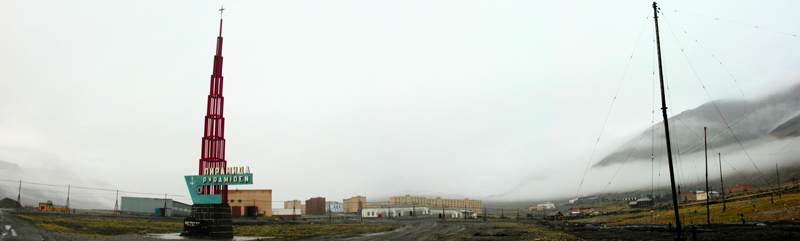
A thriving coal-mining town sold by Sweden to the former Soviet Union in the early 1920s fell victim to a classic case of soviet state-run company decision-making. Once the town was deemed insufficiently necessary and productive for the government’s purposes it was summarily and suddenly evacuated in its entirety. The population left many relics and furniture items behind which tourists can see through the windows – but not up close as visitors are forbidden (for safety reasons) from entering.

vía 24 Tales of Ghost Towns and Abandoned Cities Deserted Mining Town of Pyramiden, Sweden – WebUrbanist.

Pyramiden [78° 39.3′ N 16° 20′ E]

By Bjørn Fossli Johansen (ed.), Jørn Henriksen, Øystein Overrein, Kristin Prestvold

The Russian mining settlement of Pyramiden was discontinued and abandoned in 1998. Since then time has virtually been standing still here. With its wide streets and planned town-structure the place is a witness to the Soviet presence on the islands in the 1970s and 1980s. Everything here was designed with effectiveness and with mining in mind, but also with the intention of taking care of the workers’ welfare and family life. In contrast to the male dominated Longyearbyen, a community of families was characteristic for the Russian settlements.

Deserted Mining Town of Pyramiden, Sweden - Foto: WebUrbanist

Pyramiden Maps

Bookmark and Share

Pyramiden – De Wikipedia

Pyramiden (DanishNorwegian and Swedish meaning «the pyramid», Russian: Пирамида, piramida) was a Russian settlement and coal mining community on the archipelago of SvalbardNorway. It was founded by Sweden in 1910, and sold to the Soviet Union in 1927.

It lies at the foot of the Billefjorden on the island of Spitsbergen, and is named for the pyramid-shaped mountain adjacent to the town. The settlement, with a one time population of over 1,000 inhabitants,[1] was abandoned January 10, 1998 by its owner, the state-owned Russian companyArctikugol Trust, and is now a ghost town. Within the buildings things remain exactly as they were left, abandoned in a hurry.

There are no restrictions on visiting Pyramiden. However, visitors may not enter any buildings without permission, even if the doors are open, due to the health and safety hazards involved. Most buildings are now locked. Pyramiden is accessible by boat or snowmobile. Guided tours are available in Russian, Norwegian, and English.

The nearest settlements are Svalbard’s capital, Longyearbyen, some 50 km to the south,Barentsburg approximately 100 km south-east and the small research community of Ny-Ålesund, 100 km to the west.

Centralia, Pennsylvania – Wikipedia (Sitios fantasma VI)


Centralia

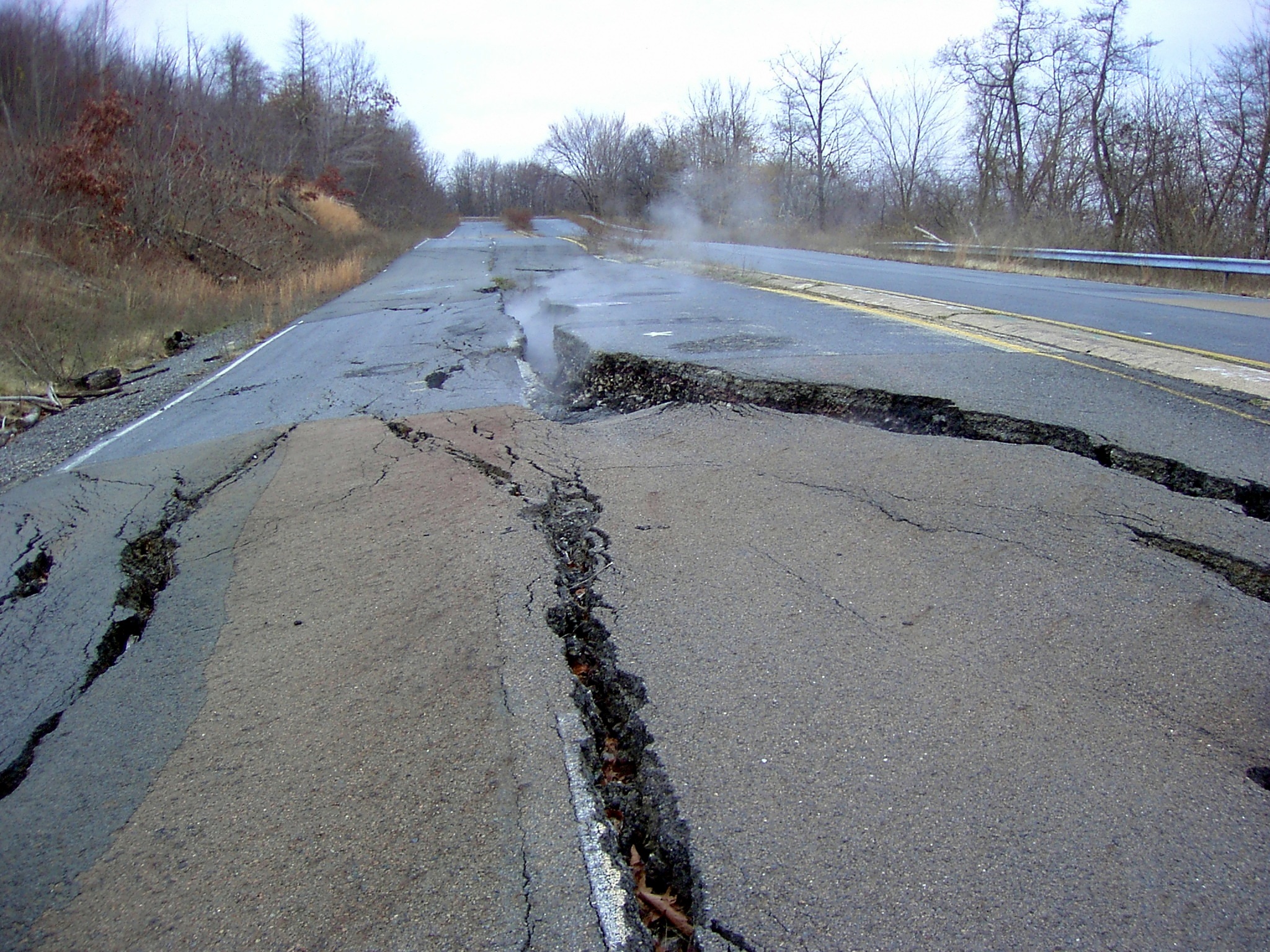
Carretera "Route 61" rota por el calor del carbón ardiendo debajo, en Centralia. Foto: Wikipedia

Centralia es un municipio en el condado de ColumbiaPennsylvania, en los Estados Unidos. En 1981 había más de 1.000 habitantes, pero la población disminuyó a 12 como resultado de incendiarse (y no apagarse desde entonces) una vieja mina de carbón que arde debajo de la ciudad. En la actualidad es el pueblo con menor población del estado de Pennsylvania.

Centralia sirvió de inspiración del videojuego Silent Hill.

De Wikipedia

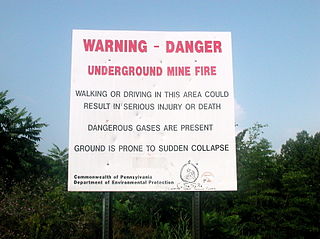
Centralia is a borough and ghost town in Columbia County, Pennsylvania, United States. Its population has dwindled from over 1,000 residents in 1981 to 12 in 2005[1] and 9 in 2007,[2] as a result of a mine fire burning beneath the borough since 1962. Centralia is now the least-populous municipality in Pennsylvania, with four fewer residents than the borough of S.N.P.J..

Like This!

Centralia is part of the BloomsburgBerwick Micropolitan Statistical Area. The borough is completely surrounded by Conyngham Township.

All properties in the borough were claimed under eminent domain by the Commonwealth of Pennsylvania in 1992 (and all buildings therein were condemned), and Centralia’s ZIP code was revoked by the Post Office in 2002.[1] However, a few residents continue to reside there in spite of a failed lawsuit to reverse the eminent domain claim.

vía Centralia, Pennsylvania – Wikipedia.

Señal de advertencia sobre el peligro del lugar. Foto: Wikipedia

Centralia Pennsylvania
…truth is stranger than fiction.
A Pennsylvania community consumed by
an underground mine fire.
If you were driving north on route 61 in the heart of the Anthracite coal region in Pennsylvania in recent years, you may have come across a detour of 61 at the top of a hill in a community called Ashland. Thinking nothing of it you would have followed the detour signs that took you around some possible road construction or a bridge being worked on. You’re then reconnected with Rt. 61 again.

Centralia (Pennsylvania)

Tras haber visto Silent Hill, justo he encendido la radio y han comentado algo en Milenio 3 que ha llamado mi atención… Se trata de un pueblo de Pennsylvania llamado Centralia, el cual inspiró al de la película Silent Hill… He buscado un poco de info…

The Smoldering Ruins of Centralia

Written by Alan Bellows on 29 March 2006

Centralia Mine Fire

No one knows exactly how it started, but a coal vein has been burning under the Pennsylvania mining town of Centralia since 1961. Some trace it back to careless trash incineration in an open pit mine igniting a coal vein. The fire crawled, insidiously, along coal-rich deposits far from the miner’s pick, venting hot and poisonous gases up into town, through the basements of homes and businesses.

Centralia, Pa., coal fire is one of hundreds that burn in the U.S.
The underground coal fire that has slowly consumed Centralia, Pa., isn’t unusual. Many such fires burn around the world.

The fire burning deep below Centralia, Pa., is just one of numerous coal fires burning in at least 20 states today, with thousands more worldwide. They gobble up resources, spew dangerous emissions, and scar the land. Yet little is known about their impact on climate change or human health due to carbon dioxide and mercury emissions, say experts.

Bookmark and Share

Taringa! – Pripyat ciudad fantasma – Chernobyl (Sitios fantasma V)


Vista aérea de la ciudad abandonada de Propyat, Ucrania. Foto: WebUrbanist

Pripyat es una ciudad fantasma al norte de Ucrania en la región de Kiev, en cercanías de la frontera con Bielorrusia, la actual Belarús. Que debe su nombre al río que atraviesa la ciudad.

Like This!

Qué pasó

Esta ciudad es conocida porque sufrió el peor accidente de la historia de la energía nuclear el 26 de abril de 1986 cuando se produce el sobrecalentamiento y explosión del reactor número 4 de la planta nuclear de Chernobyl, el cual emitió 400 veces más radiación que la bomba atómica que cayó sobre Hiroshima en 1945, por lo que la ciudad se vio afectada por la radiación y debió ser evacuada. La evacuación fue llevada a cabo en tan solo tres horas por el ejército ruso, cuando la mayoría de los habitantes fueron desalojados de sus casas contra su voluntad, y los animales domésticos y de ganado fueron sacrificados.

vía Taringa! – Pripyat ciudad fantasma (Chernobyl).


Bookmark and Share


Pripyat – La ciudad envenenada –

A lo largo y ancho del planeta, existen multitudes de pueblos y ciudades fantasmas, pero probablemente, ninguna tan espectacular como Pripyat. Esta floreciente ciudad, de 50000 habitantes, fué evacuada en menos de tres horas y desde aquel momento, hace ya 22 años. Nadie ha vuelto a pasear por sus calles.

Pripyat es una ciudad fantasma al norte de Ucrania en la región de Kiev, en cercanías de la frontera con Bielorrusia, la actual Belarús. Que debe su nombre al río que atraviesa la ciudad.

The Prypiat Ferris Wheel, as seen from the City Center Gymnasium. Fuente: Wikipedia

Prypiat (city)

From Wikipedia, the free encyclopedia

Prypiat (Ukrainian: При́п’ять, Pryp”jat’; Russian: При́пять, Pripjat’), is an abandoned city in the zone of alienation in northern Ukraine, in the Kiev Oblast (province), near the border with Belarus[2]. The city has a special status within the Kiev Oblast subordinating directly to it, although is located in the Ivankiv Raion (district). The city also is being supervised by the specially assigned ministry as part of the Zone of alienation. Prypiat was founded in 1970 to house the Chernobyl Nuclear Power Plant workers, officially proclaimed a city in 1979, and was abandoned in 1986 following the Chernobyl disaster. It was the ninth nuclear-city, «атомоград» (atomograd) in Russian, literally «atom city». Its population had been around 50,000 before the accident. Annual growth of population was estimated at around 1,500 including 800 new-born citizens and over 500 newcomers from all the corners of the Soviet Union. It was planned that the Pripyat’s population should rise up to 78,000 in the nearest future. Prypiat had a railroad link to Kiev Yazov station as well as a navigable river nearby.


Actualización: 20 de septiembre de 2010

Avance: Cuarto Milenio entra en la zona restringida de Chernobil

https://twitter.com/#!/arquitectonico/status/99880650701672448

Gunkanjima, una isla-ciudad fantasma en Japón | Fede Aikawa (Sitios fantasma IV)


Buildings and the "Stairway to Hell", inside of Hashima Island - Foto: Wikipedia.

Like This!

Leo en ALT1040, un curioso top ten de ciudades abandonadas en el mundo. Una de ellas es Gunkanjima, una isla en Japón, cercana a la prefectura de Nagasaki, que en la década de los 40/50 tuvo su momento de mayor esplendor y fue uno de los lugares con mayor densidad poblacional del planeta Tierra.

Todos los habitantes de la isla, dependían de la producción de las minas de carbón, las cuales en la década de los 70 quedaron completamente agotadas. Es por ello que todos sus habitantes debieron migrar hacia otros lados. La empresa que comenzó a construir la ciudad en la isla (Mitsubishi) fue la encargada de decretar el cierre de la mina.

vía Gunkanjima, una isla-ciudad fantasma en Japón | Fede Aikawa.

Gunkanjima, la isla abandonada de Hashima

En la costa de Nagasaki, Japón, se encuentra una de las islas abandonadas más famosas del mundo, la isla de Hashima, también apodada “Gunkanjima” o “barco de guerra” en japonés, por la silueta que adquirió cuando fue amurallada para protegerla de los envites del mar.

La fascinación que despierta contemplar una ciudad moderna abandonada como Prypiat o Varosha, probablemente se deba a la estampa apocalíptica que supone ver hecho realidad el futuro que aguarda al mundo cotidiano que nos rodea; ciudades otrora bulliciosas, convertidas en naturalezas muertas, con sus calles desiertas y las sombras fantasmagóricas de sus edificios deshabitados, descomponiéndose lentamente con el paso del tiempo.

Sin embargo Hashima tiene algo que la hace especial; no fue abandonada por causas de fuerza mayor, guerras o un desastre nuclear, fue abandonada por motivos económicos. Al cerrarse la única explotación minera de la isla, sus empleados perdieron su trabajo de la noche a la mañana y se vieron obligados a abandonar la isla, seguidos por todo el sector subsidiario y de servicios creado alrededor, que se desmoronaba como un castillo de naipes.

Bookmark and Share

Hashima IslandDe Wikipedia

Hashima Island (端島?, or correctly Hashima, as -shima is Japanese for island), commonly called Gunkanjima or Gunkanshima (軍艦島; meaning Battleship Island), is one among 505 uninhabited islands in the Nagasaki Prefecture about 15 kilometers from Nagasakiitself. The island was populated from 1887 to 1974 as a coal mining facility. The island’s most notable features are the abandoned concrete buildings and the sea wall surrounding it. It has been administered as part of Nagasaki, Nagasaki since 2005; it had previously been administered by the former town of Takashima.

Varosha: Un Paraíso Abandonado – Viajar Sin Brújula (Sitios fantasma III)


Crumbling hotels in Varosha - Foto: Wikipedia

Chipre

Bookmark and Share

Antes un paraíso, hoy un pueblo fantasma

Por Juan Luis Pérez

Like This!

Muchas veces los hombres comenten un sin fin de equivocaciones, por decirlo de alguna manera, que las acciones que generan son que pueblos y ciudades queden abandonadas, sumando más lugares a las listas de pueblos fantasmas. Uno de ellos es Varosha que desde hace 35 años forma parte de este triste y celebre listado.

Esta triste ciudad se encuentra en el distrito greco – chipriota, y tuvo su mayo apogeo durante la década del setenta, donde este lugar era conocido en el mundo como un centro turístico de clima mediterráneo con de hermosas playas blancas de aguas cristalinas, que lo habían convertido en el lugar preferido de las celebridades de Hollywood quienes lo frecuentaban asiduamente.

Entre los famosos de ese momento que concurrían a disfrutar de los placeres de esta ciudad estaban Elizabeth Taylor, Raquel Welch, Brigitte Bardot entre otras figuras que también aportaban su glamour a estas costas paradisiacas. Que además se iba trasformando en uno de los lugares con mayor progreso económicos y turístico.

Hasta que todo esto se termino, cuando a mediados de 1974 cuando fue tomado, junto con el distrito al norte de Chipre por las tropas turcas.

La población que en ese entonces llegaba a unos 45.000 habitantes, de origen griego, debió huir, abandonando sus pertenencias y propiedades.

Desde ese entonces Chipre quedo dividida en dos partes, Al sur esta ocupado por los Greco- chipriotas y el norte habitado por los turco- chipriotas. Mientras que en le medio quedo Varosha con sus decenas de hoteles de varias categorías que alguna vez fueron el orgullo turístico, y que estan totalmente abandonados y bajo el control de los turcos.

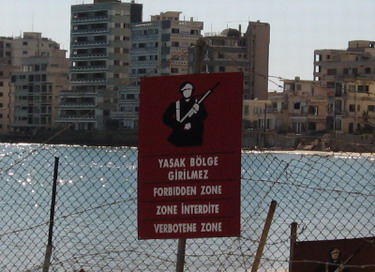
En la actualidad es acceso a esta bella ciudad esta totalmente prohibido, como también la ocupación de la misma por conformidad a una resolución de la ONU desde 1984 que “prohibe todo asentamiento en el lugar a personas que no sean sus habitantes originales los greco-chipriotas”.

vía Un Paraíso Abandonado – Viajar Sin Brújula.

De Wikipedia

Varosha, as seen from outside the military fence

Varosha (Greek: Βαρώσια; Turkish: Maraş) is a quarter in the Cypriot city of Famagusta. Prior to the Turkish invasion of Cyprus in 1974, it was the modern tourist area of Famagusta.

La ciudad fantasma de Varosha. De como un centro turístico se convirtió en un lugar desolado.

El paraíso robado

Existen mil razones por las que pueblos y ciudades quedan en ocasiones abandonados y pasan a engrosar la lista de pueblos fantasma, pero sin duda, los motivos por los que Varosha pasó a formar parte de esta lista, hace ya 35 años, es uno de los peores: la codicia, los fanatismos y la estupidez humana que más veces que menos nos lleva a encontrarnos en situaciones tan tristes como la de esta ciudad.

Varosha, ciudad fantasma de Chipre

Varosha fue en el pasado una ciudad muy turística, un lugar de encuentro con muchas estrellas y sin duda fue un destino agradable para pasar el verano. Todo se acabó en 1974 gracias a los turcos, que llegaron a la ciudad, la invadieron y sacaron a todas las personas que vivían en la ciudad, que en el aquel entonces eran unas 45.000 personas y todas ellas fueron obligadas a dejar sus casas, sus propiedades, su vida. Los soldados turcos fueron los encargados de asediar esta ciudad y destruir todo lo que había en ella.

La fotografía procede del artículo The Ghost City of Cyprus de Michael J. Totten.

Varosha, ciudad fantasma

Por fraxi

Varosha, el distrito greco-chipriota del centro turístico costero de Famagusta, fue tomado por las tropas turcas junto con el norte de Chipre a mediados de agosto de 1974. La llegada de los soldados de Ankara obligó a más de 45.000 habitantes de origen griego a escapar y dejar atrás sus propiedades.
Desde entonces, el acceso a la ciudad, que cuenta con decenas de hoteles y alguna vez fue el orgullo de la industria turística chipriota, se encuentra prohibido de conformidad con una resolución de la ONU de 1984 que prohibe todo asentamiento en el lugar a personas que no sean sus habitantes originales, los greco-chipriotas.

Breve información, en español, sobre el problema de Varosha (unoy dos). La fotografía procede del artículo The Ghost City of Cyprus de Michael J. Totten.

Varosha, la ciudad fantasma de Famagusta, Chipre
COMPENDIUM

Varosha es una de las ciudades modernas abandonadas más famosas del mundo junto a otras como Hashima o Pripyat, que gracias al interés que despierta su estampa completamente freaky, ha mantenido de alguna forma vivo el recuerdo de la guerra y ocupación de Chipre, causando el efecto contrario al que probablemente pretendían sus conquistadores cuando la cerraron.

Hay que aclarar que Varosha no es una “ciudad”, es un barrio al sur de Famagusta, la antigua capital de la segunda provincia más grande de Chipre, también llamada Famagusta.

La confusión surge cuando el periodista sueco Jan-Olof Bengtsson visita el sector y lo califica de “ciudad fantasma” en un artículo sensacionalista publicado en el Kvällsposten el 24 de Septiembre de 1977, 3 años después de que fuera ocupado por fuerzas turcas y sellado, convirtiéndose en una zona de exclusión a la que sus habitantes nunca pudieron regresar.

San Zhi, un pueblo fantasma futurista « Tejiendo el mundo (Sitios fantasma II)


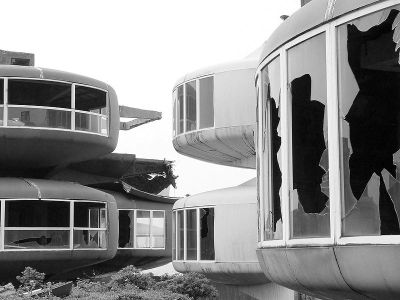
Many of the pod buildings have broken windows. Wikipedia

Bookmark and Share

Sanzhi UFO houses – De Wikipedia

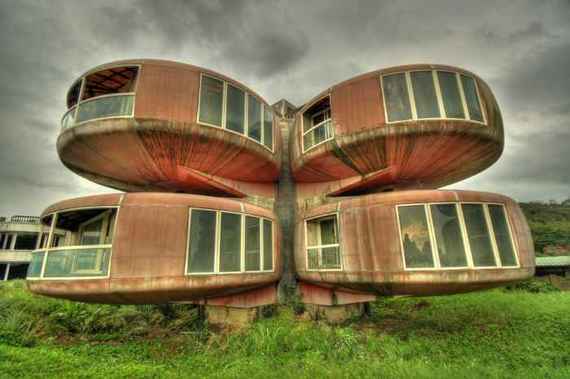
The Sanzhi UFO houses (三芝飛碟屋), also known as the Sanzhi pod houses or Sanzhi Pod City, were a set of abandoned pod-shaped buildings in Sanzhi, Taipei County, Taiwan.

Like This!

Más que pueblo fantasma, catalogaría San Zhi como urbanización fantasma por las características de este lugar. Está situada en las afueras de Taipei, en Taiwan, y se construyó a principios de los ochenta como lugar de residencia de lujo. No se conocen los nombres de los diseñadores de esta urbanización futurista, a mi personalmente, estos edificios me recuerdan muchísimo a los de la película de Woody Allen “El dormilón”,jeje… igual fueron los mismos. Bueno, la cosa es que apenas hay información sobre este lugar y sobre las causas de su abandono. Hay teorías para todos los gustos, un tifón que arruinó a la constructora, o una quiebra de ésta simplemente. Muertes de obreros, con sus respectivos espíritus atormentando al resto de trabajadores hasta que abandonan el trabajo por temor… quien sabe, la verdad es que ninguna es demasiado creíble. Es posible que todo sea más simple y que las causas no sean tan rocambolescas. La cuestión es que San Zhi es el mejor ejemplo de cómo serán las ciudades del futuro cuando sean abandonadas. Un lugar diferente, colorido y tan muerto como el resto de pueblos fantasma.

vía San Zhi, un pueblo fantasma futurista « Tejiendo el mundo.

The Mysterious Abandoned Pod City of San Zhi

Spirits In The Ghost Town of San Zhi

On the north coast of Taiwan lies the strangest abandoned city San Zhi. The city is entirely consisted of circular multi-colored pods stacked one on another. Furthermore, these strange habitats have been completely abandoned for a number of years, and are slowly rotting away into nothing. The site was commissioned by the government, and this was mentioned to be a nice place to get rest and enjoy the view, but something went wrong. No body actually knows what happened, but the rummer goes that a lot of strange and bizarre things and accidents happened which scared people. Locals say that the area is hunted by the ghosts who died in vain. Well, that stories about the hunted places are very popular and it is a common thing which we can find it anthropologically in lot of cultures all over the world.

San Zhi UFO houses are destroyed! (三芝飛碟屋 拆毁)


Entrada anterior en ArquitecturaS:

Epecuén, el pueblo que emergió de las aguas (Sitios fantasma I)

– Sponsored:

Diseña un sitio como este con WordPress.com
Comenzar