The annual accolade is given to individuals or practices in recognition of major international contributions to both the theory and practice of architecture.
Rem Koolhaas will receive the high-profile award on Tuesday 20 November at the RIBA’s in London headquarters and deliver a public lecture chaired by Charles Jencks.
Charles Jencks said: ‘Rem Koolhaas, more than any other architect of his generation, has built a parallel life between the theory and practice of architecture.
‘This double commitment was explicitly marked in 1999 as his twin studios, OMA and AMO, the Office of Metropolitan Architecture and the Architecture Media Organisation.
The Royal Institute of British Architects (RIBA) has announced Rem Koolhaas as the recipient of the 2012 Jencks Award.
Given annually to an individual (or practice) that has recently made a major contribution internationally to both the theory and practice of architecture, the award will be presented to Koolhaas on November 20th at the RIBA in London.
The event will also feature a public lecture by Koolhaas, chaired by architectural theorist Charles Jencks.
The RIBA stated: “Through his research and experimentation as well as his built projects and literature, Rem Koolhaas consciously works to deepen and expand the intrinsic connection between architecture and contemporary culture.”
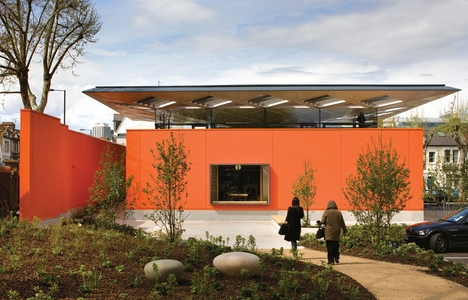
The judges described the London cancer centre as a “timeless work of architecture that not only distils the intentions of this brief but expresses in built form compassion, sensitivity and a deep sense of our common humanity.”
They added: “This quietly confident building is truly, unquestionably a haven for those who have been diagnosed with cancer. Rogers Stirk Harbour & Partners’ achievement is in having created a completely informal, home-like sanctuary to help patients learn to live with cancer.”
In his short acceptance speech, Richard Rogers described the building as a “wonderful project”.
He paid tribute to Maggie Keswick, the late wife of client Charles Jencks, who’s death of cancer led Jencks to create a series of cancer care centres as a fitting memorial.
Rogers said: “The one person missing here is Maggie. She will certainly be the person I’m thinking of.”
LORD ROGERS last night won the £20,000 Stirling Prize, the premier award in British architecture, for his design of a cancer support centre.
The prize comes as a ringing endorsement from his peers despite Rogers being bumped off the £1 billion Chelsea Barracks redevelopment project by the intervention of Prince Charles. His victory — for the Maggie’s Centre in Hammersmith, west London — came as a surprise. The favourite for the award had been an art gallery on a Danish island by minimalist architect Tony Fretton.
Giving the prestigious prize to the firm of Rogers Stirk Harbour was a popular choice, however. The programme of Maggie’s Centres began with a converted stable block in Edinburgh in 1996.
The six centres built so far are architecturally ambitious. Five are in Scotland, including designs by Frank Gehry (Dundee) and Zaha Hadid (Fife). Sarah Brown, the prime minister’s wife, was closely involved with the building of the Fife Maggie’s Centre, which is in her husband’s constituency.
The RIBA Stirling prize is given each year to one selected building. And this year’s prize went to the Maggie Center by Rogers Stirk Harbour + Partners.
Richard Rogers takes architecture’s top prize for the second time
Richard Rogers’ Maggie’s Centre in west London has been awarded the RIBA Stirling Prize for 2009, announced at a televised ceremony on Saturday. From a shortlist of six, Rogers’ design won the £20,000 prize making this the second time his practice has achieved what is considered to be one of the most prestigious architecture prizes. Rogers’ Barajas Airport in Spain scooped the top spot in 2006.
Maggie’s Centre, a cancer care centre in London designed by architects Rogers Stirk Harbour + Partners, has won the RIBA Stirling Prize for the best building designed by a British architect.
El estudio Richard Rogers Stirk Harbour and Partners obtuvo el premio RIBA por segunda vez, por un centro para enfermos de cáncer en Londres; el primero fue en 2006 por la Terminal 4 de Barajas, Madrid





 Arquitectonico
Debe estar conectado para enviar un comentario.