Los atentados del 11-S y el derrumbe de las Torres Gemelas cambiaron la manera de hacer arquitectura y «demostraron la fragilidad del hombre», sostiene el célebre arquitecto suizo Mario Botta.
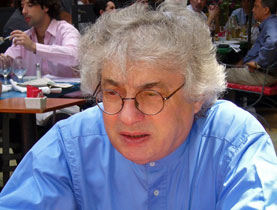
Mario Botta, arquitecto suizo, en un momento de la entrevista con swissinfo en Buenos Aires. () http://www.swissinfo.ch
«Pensábamos que hacíamos cosas eternas y, sin embargo, en pocos años o en pocas décadas veremos que queda muy poco de nuestra cultura». Entrevista.
Siempre sonriente, con un enorme sentido del humor y mientras garabateaba un dibujo para su entrevistadora, Mario Botta pensó refinadamente cada una de sus respuestas sin desviar la atención de lo que él considera la esencia de la buena arquitectura: la mirada sobre el contexto histórico y ambiental a la hora de pensar una obra.
“In a certain sense, we’re the new luxury exports,” Botta, 68, said in an interview at his Mendrisio, Switzerland, office in the southern Alps. “Swatch helps the image of Swiss architecture as well even if it only makes watches.”
Switzerland’s wealth, quality of construction and reputation for precision have promoted a style of architecture that started with Le Corbusier, whose face adorns the Swiss 10- franc note. Yet in the land of Alpine peaks, the tallest building is the new Swiss Prime Tower in Zurich at just 36 stories. Switzerland’s limits on size means architects often go abroad seeking new challenges on a bigger canvas.
“You cannot become a star in Switzerland, the country simply is too small and there aren’t that many big projects where architects can reach international fame,” said Christian Schmid, who teaches at the Swiss Federal Institute of Technology or ETH. Still, “there’s a very lively architectural scene in Switzerland with many good architects.”
Swiss Architectural Stars
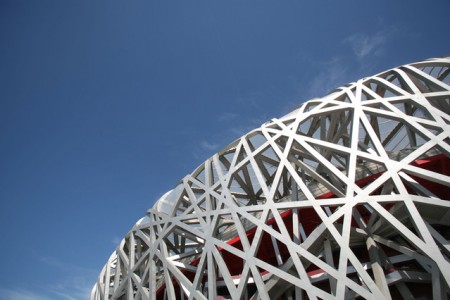
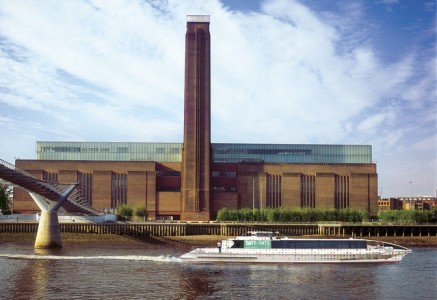
The Swiss have proven that architectural prowess needs no translation, with Jacques Herzog and Pierre De Meuron creating the “Bird’s Nest” for the Beijing Olympics and converting a London power plant into the Tate Modern Museum, seen here. Source: Tate Press Office via Bloomberg
Since 2001, Switzerland’s Peter Zumthor and partners Herzog and De Meuron have won the annual Pritzker Prize, the most important global prize in architecture. This year’s award went to Chinese architect Wang Shu, whose works feature recycled bricks and salvaged roofing tiles.
Important architects are chosen for the pavilion, “and among the big names in the world, there are just very many Swiss, which is incredible,” Hans-Ulrich Obrist, co-director of the Serpentine Gallery and Swiss, said in a phone interview.
Thermal Spa
“The constraints that Switzerland has, such as the topography, create very interesting and dynamic architecture.”
Such topographical challenges in a nation where 40 percent of the terrain is mountains proved little issue for Zumthor, who built the Vals thermal baths southwest of Davosusing 60,000 slabs of local rock.
Besides terrain, costs in a country of almost 8 million residents are also important after the Swiss franc reached near- parity with the euro last year, denting exports.
Local acceptance is crucial to the Swiss style of democracy, with popular votes held to approve large projects. Switzerland’s last big concert hall survived four referendums before it was finished in 2000 by Nouvel on Lake Lucerne. Nouvelalso designed packaging for Nestle SA (NESN) to revamp a chocolate brand.
Switzerland’s populace can be “perplexed by large and expensive projects,” Schmid said.
El maestro suizo, autor de la reestructuración de la Scala de Milán, numerosas viviendas y edificios religiosos, opina sobre su forma de trabajar, la enseñanza universitaria, y acerca de la arquitectura y la ciudad contemporáneas.
lanacion.com| Arquitectura | Miércoles 10 de diciembre de 2008
– – – – – Tuve el honor de conocer a Mario Botta en Caracas, a finales de los ochentas, en ocasión de la celebración del Día del Arquitecto (por aquel entonces aún se le daba más importancia al conocimiento y la profesión que a las fiestas y el marketing) Su conferencia, en el Museo de Bellas Artes, fue extraordinaria, aumentando aun más, si es posible, la admiración que por su obra mantengo.
– – – – –





 Arquitectonico
Debe estar conectado para enviar un comentario.