(Latin architectura, from the Greek ἀρχιτέκτων – arkhitekton, from ἀρχι- «chief» and τέκτων «builder, carpenter») is the art and science of designing buildings and other physical structures. Wikipedia.
For architects and interior designers, creating an impression that is as identical as possible to the final product is an essential element of their professions.
3D-compatible Samsung UNC7000 series. Experts say that the increasing adoption of 3D imaging and architectural animation has resulted in more accurate representations, convenience and saves clients time and money in construction projects. Photo/FILE
Most clients desire to see their buildings or interior spaces transformed into the ideal concept they had visualised. The architects are tasked with the unenviable responsibility of making this happen.
Not so long ago, building plans used to be done and presented entirely on paper, consuming a lot of resources, time and labour.
However, an architectural job that could typically have taken up to three months in the past can now take two weeks.
Experts say that the increasing adoption of 3D imaging and architectural animation has resulted in more accurate representations, convenience and saves clients time and money in construction projects.
According to Waweru Njuguna, an architect and interior designer at Synergy Arc, an architectural firm in Nairobi, use of digital imaging in architecture boosts accuracy and speed in design.
“It’s now become much easier to show the client exactly what you want to build and the projected outcome using 3D models and animation,” says the architect. “In addition to this, changes and manipulation could easily be factored in as the project progresses eliminating the hassle of having to redo entire plans.”
Adds Njuguna: “If, for example, you are changing the flooring from wood to carpet, you can easily go back to your project design on the computer, make the changes and have the new layout reflect on the final design.”
This according to Njuguna, has made consultation between the design team and the clients easier and as such, proposals are developed much faster.
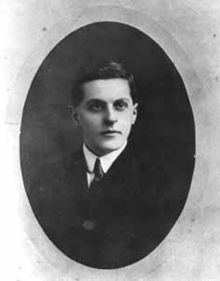
Retrato de Wittgenstein dedicado a su amigo Eccles en 1910 - Wikipedia
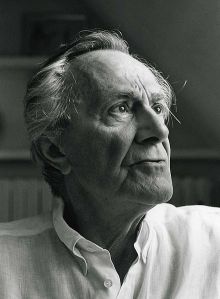
Broadly and variously defined, postmodernism refers to a specific period of time that began in the 1940s, a style of literature, architecture, art philosophy, or the plight of Western society in post-capitalist age. This movement encompasses a set of critical and rhetorical practices employing concepts such as difference, repetition, and hyperreality to break apart or deconstruct other the structural elements achieved through modernism, including temporality, presence, identity, historical progress, epistemic certainty, and meaning achieved through unity. The term “postmodernism” first entered the philosophical lexicon in 1979, with the publication of The Postmodern Condition, by Jean-François Lyotard, in which Lyotard utilizes Ludwig Wittgenstein’s model of language games and concepts taken from speech act theory to account for “a transformation of the game rules” for science, art, and literature. For Lyotard, postmodern thought can best be summed up as “incredulity towards meta narratives.” According to Lyotard, postmodernists eschew “grand narratives” that attempt to account for, explain, and compartmentalize human life and history; there is no clearly defined, collective meaning and for the postmodern world, there is no mourning of the loss of meaning because the outcome of one’s own experience and condition will necessarily be fallible and relative, rather than exact and universal.
Jean Baudrillard, another influential postmodernist, deviates slightly from standard principles and presents a highly dystopic definition of the postmodern world, stating that we have lost what is “real” and that we have nothing left except a preoccupation with its disappearance. The loss of certain historical myths, the onslaught of mediatization, the spread of the kitsch, and consumerism all combine together to form this postmodern, apocalyptic present. Generally speaking, postmoderncritics, largely inspired by the postmodern world in which they live, attempt to rethink and reconfigure a number of concepts touted by Enlightenment humanism and modernism including subjectivity, temporality, progress, empiricism, and the rule of law. Without the required modern unity of the subject and the pressure of seeking cohesive meaning in a modern state, the faculties are set free to operate on their own, thus constantly inventing, reinventing and recreating imagination, understanding, and reason.
Jean-François Lyotard. Wikipedia
RESOURCES FOR FURTHER EXPLORATION
General Information on Postmodernism and Critical Theory Comprehensive guides especially helpful for those interested in other theories, such as Gender and Sex, Marxism, Narratology and New Historicism.
Specific Postmodern Definitions and Information Find out more about the movement here, including specifics on criticism, language, construction, and Jacques Derrida.
Publications Published by Johns Hopkins University Press, Postmodern Culture is the leading electronic journal for contemporary and interdisciplinary thought. Conduct research and search for articles of interest here.
The California College of the Arts in San Francisco presents a mazelike exhibition of the work of 60 artists and architects through April 7. http://www.sfgate.com
It’s a mazelike immersion where Richard Serra‘s rusted steel «Sequence» unwinds beneath the fog-shrouded Blur Buildingof Diller Scofidio + Renfro, an arm’s length away from Andy Goldsworthy‘s «Faultline.» Sixty architects and artists are represented in all, and an equal number of creative provocations.
What’s on display isn’t the physical work itself, but diagrams, studies and images transferred to sequences of frosted acrylic panels. Each rectangular panel is connected by hinges to the panels alongside, above and below it. The interconnected panels – think flattened chains in taut rows – are then hung from the ceiling by thin steel cables.
The various strands all start at the exhibition’s outer four edges and twist and snap toward a central core, leaving just enough space for passageways from each side that visitors can follow. Plunging in, we encounter work by such emerging locals as Iwamoto Scott and Future Cities Lab as well as Big Names such as Serra and Goldsworthy.
This is the latest installment of the «Way Beyond Art» series at the college’sWattis Institute for Contemporary Arts. It was co-curated by Ila Berman, director of the architecture program, and architect Douglas Burnham. Their goal: to convey what the wall text calls «a new and expanding network of relations between the domains of architecture, sculpture, interiors and landscape.»
Architecture in the Expanded Field is designed and curated by Ila Berman, CCA director of Architecture, and Douglas Burnham, CCA adjunct professor and principal of envelope a+d. It explores the realm of installation art and architecture across a broad terrain of practices, ranging from the immersive environments of Ryoji Ikeda, Tomas Saraceno, and Philippe Rahm to the deconstructions of Gordon Matta-Clark and the spatial distortions and tectonic manipulations of Softlab, Numen / For Use, Gramazio & Kohler, and theverymany. The exhibition has two components: an immersive full-scale installation (both within and outside the gallery) and a didactic «surface» component that presents the mapped expanded field of architectural installation.
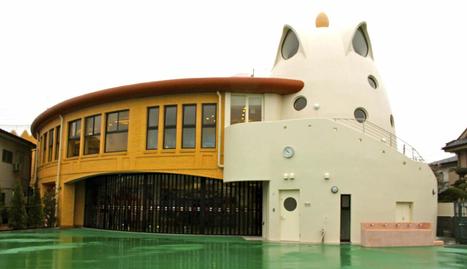
Imagen de la guardería japonesa inspirada en Antoni Gaudí, obra del arquitecto Hiroya Tanaka. :: EFE - http://www.diariodenavarra.es
Inspirada en la obra de Gaudí y en la imaginación de los niños, abrió sus puertas en Fuchu, oeste de Tokio, la primera guardería japonesa inspirada en el diseño del arquitecto modernista español, informó este domingo su autor, Hiroya Tanaka.
El arquitecto nipón, nominado a los Premios Príncipe de Asturias en 2004 y considerado uno de los mayores expertos en la obra de Gaudí, afirmó inspirarse para el proyecto en el genio catalán, aunque reconoció que el proyecto tomó forma cuando creó talleres en los que los niños del centro, de hasta seis años, participaron en el diseño.
«Comencé a aplicar elementos ‘gaudianos’ en el diseño de la guardería, pero con la aportación de los niños en la estructura del edificio, los muebles y la artesanía, todo se fue transformando y se convirtió en algo muy colorido», apuntó Tanaka(Hokkaido, 1952).
El diseño subraya la identidad de Gaudí al utilizar «elementos de la naturaleza para transformar la arquitectura», con ejemplos como las «líneas onduladas de la cubierta, que permiten a los niños ver el exterior mientras juegan, las escaleras con formas ovaladas o el uso de un tragaluz para aprovechar la luz natural», afirmó Tanaka.
Con un coste aproximado de más de 300 millones de yenes (unos 2,7 millones de euros), la guardería «Kitayama Kindergarden» se inauguró oficialmente el sábado último en una ceremonia en la que estuvo presente el arquitecto japonés, que reside en Barcelona desde hace más de 35 años.
El proyecto se remonta a 2007 cuando la directora del centro de Fuchu le pidió que creara una escuela al estilo de Antoni Gaudí.
«Vino a visitarme a Barcelona porque quería un edificio conmemorativo que reemplazara a la antigua escuela que tenía ya más de 60 años, y quería un cambio con inspiración de Gaudí», dijo el autor en una entrevista.
El arquitecto, fundador del «Club Gaudí» de Barcelona, detalló que para realizar su obra trasladó cerca de 70.000 ladrillos desde Bailén (Jaén, sur español) ya que son «de mayor calidad e incluso con el transporte desde España, salen mucho más baratos que comprarlos en Japón», detalló.
Autor de libros como «Colección de edificios de Gaudí» o «Una palabra de Gaudí», Tanaka, que regresará a España el próximo 7 de abril, aprovechó también la visita a su país natal para presentar su nuevo libro en japonés, en el que analiza sus hallazgos sobre las mediciones arquitectónicas en la obra de Gaudí.
El arquitecto asegura que son de más calidad y que hasta con los portes salen más baratos que los del país
EFE | TOKYO.
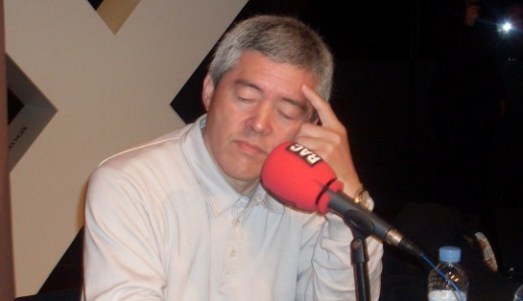
Dr. Hiroya Tanaka - rac1.org
Inspirada en la obra de Gaudí y en la imaginación de los niños, ha abierto sus puertas en Fuchu, oeste de Tokio, la primera guardería japonesa inspirada en el diseño del arquitecto modernista español, informó ayer a Efe su autor, Hiroya Tanaka. El arquitecto, fundador del ‘Club Gaudí’ de Barcelona, detalló que para realizar su obra trasladó cerca de 70.000 ladrillos desde Bailén ya que son «de mayor calidad e incluso con el transporte desde España, salen mucho más baratos que comprarlos en Japón», detalló.
El arquitecto nipón, nominado a los Premios Príncipe de Asturias en 2004 y considerado uno de los mayores expertos en la obra de Gaudí, afirmó inspirarse para el proyecto en el genio catalán, aunque reconoce que el proyecto tomó forma cuando creó talleres en los que los niños del centro, de hasta seis años, participaron en el diseño.
«Comencé a aplicar elementos ‘gaudianos’ en el diseño de la guardería, pero con la aportación de los niños en la estructura del edificio, los muebles y la artesanía, todo se fue transformando y se convirtió en algo muy colorido», apuntó Tanaka (Hokkaido, 1952).
Considerado uno de los grandes expertos en la obra del creador universal, ‘El Festival de una flor’ acoge hoy su conferencia en El Capricho «Algún día se terminará la Sagrada Familia, el tiempo no es importante»
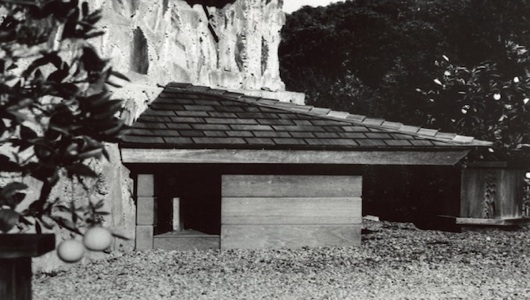
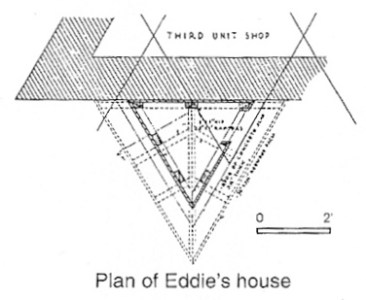
One of Frank Lloyd Wright‘s decidedly lesser-known works, a 1956 doghouse designed for a black Lab named Eddie, has been reconstructed complete with leaky roof.
In 1956, 12-year-old Jim Berger decided that it was high time that his loyal black Lab, Eddie, got a proper backyard doghouse. So, Berger took it upon himself to pen a letter to the same architect that designed his family’s home in Saint Anselmo, Calif. In his letter, Berger asked the architect if he would be so kind as to design the doghouse himself as so the two structures would not clash. He offered to pay for the design with money earned on his paper route.
Wrote Berger in his letter, dated June 19, 1956: “I would appreciate it if you would design me a doghouse, which would be easy to build, but would go with our house … (My dog) is two and a half feet high and three feet long. The reasons I would like this doghouse is for the winters mainly.” Berger also made sure to inform the architect of Eddie‘s age: Four (human years), 28 (dog years).
The architect responded to Berger’s query, explaining to him that he was too busy at the moment to take on such an «opportunity» but would consider it later in the year when his schedule was less hectic. «I may have something then,» he wrote. In November of that year, Berger followed up with a second letter and, lo and behold, the architect then sent him a set of drawings outlining the design of Eddie’s doghouse. The architect took on his young client’s project gratis.
Oh, and did I mention that the architect that Berger solicited to design Eddie’s backyard digs was some totally obscure guy in Wisconsin named Frank Lloyd Wright?
In 1956, 88-year-old Wright probably had a few important things on his mind (i.e. the construction of what’s arguably his most iconic creation, the Guggenheim Museum in New York) other than indulging the child of a former client in Marin Country, Calif. And Wright wasn’t exactly known for being a warm and fuzzy kind of guy prone to striking up correspondences with juvenile dog owners — Wright’s legacy of arrogance, recklessness, and personal turmoil is just as famous as the hundreds upon hundreds of buildings that he brought to life. Yet somehow, Berger got through to one of the 20th century’s greatest — and most difficult — geniuses.
SAN FRANCISCO — The Solomon R. Guggenheim Museum in New York City. The Fallingwater home in southwestern Pennsylvania. But a child’s doghouse?
Frank Lloyd Wright designed hundreds of landmark buildings and homes during a prolific career that spanned more than seven decades. But in what is widely considered a first and only for the famed architect, Wright indulged a young boy’s humble request for a dog house in 1956 and sent him designs for the structure.
A doghouse designed by famed architect Frank Lloyd Wright became a cherished boyhood memory. Now the doghouse has been rebuilt and is featured in a documentary about Wright’s work called «Romanza.»
Editado por Taschen, ‘100 Contemporary Houses’ consta de dos volúmenes que revisa, con extraordinarias imágenes y cuidados textos, la mejor arquitectura moderna.
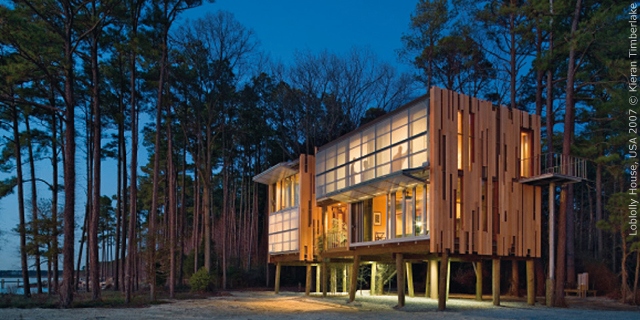
La editorial Taschen suele asombrarnos con sus cuidadísimas ediciones (las imágenes suelen ser excepcionales) de libros extraordinarios de los más variados temas. Esta vez le ha tocado el turno a las casas con los dos volúmenes titulados 100 Contemporary Houses, editado en español. Se trata de viviendas privadas, mayoritariamente del siglo XXI, que representan una selección internacional que busca evitar estereotipos. Por eso, las que aparecen en este poderoso — y muy entretenido — libro son casas grandes y pequeñas, desde Japón a California, que sirven para ofrecer una visión general de lo que hoy en día significa construir una casa con un arquitecto. Sólo hay que abrir estas páginas para disfrutar de la belleza de la arquitectura moderna.
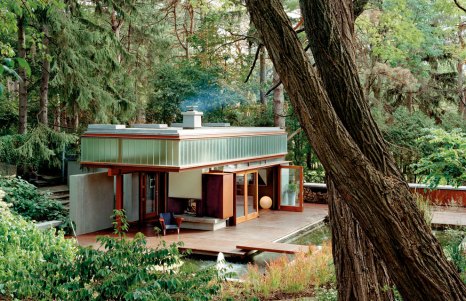
Esta casa de invitados se encuentra en una amplia finca de Toronto, Canadá. Los responsables de su diseño es el estudio de arquitectura Shim-Sutcliffe, quienes concibieron la vivienda como “una linterna reluciente en el bosque”. Foto: Raimund Koch y Shim-Sutcliffe
Casas contemporáneas excepcionales de todo el planeta, desde Chile hasta Croacia y China.
Los arquitectos gozan de mayor libertad para expresar sus ideas y probar nuevos conceptos en el diseño de residencias privadas que en los proyectos corporativos. La concepción de una casa no está exenta de complejidades a las que los arquitectos intentan responder buscando sin cesar soluciones innovadoras: parte del diseño consiste en replantearse la forma en que habitamos nuestras casas y vivimos el día a día. En la actualidad, otro factor importante es la sensibilización respecto a los asuntos medioambientales, un aspecto que ha cambiado de forma radical el terreno de juego.
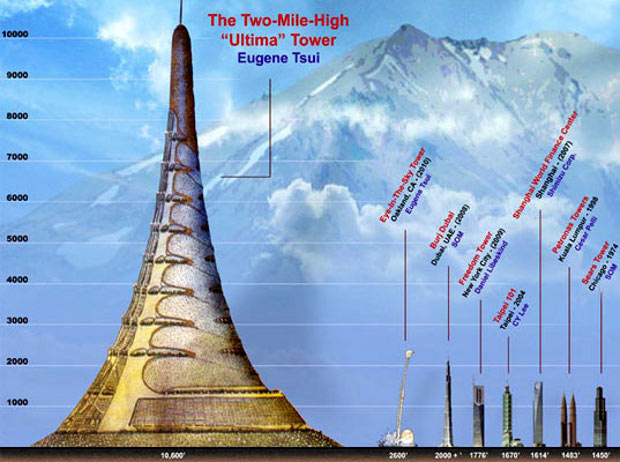
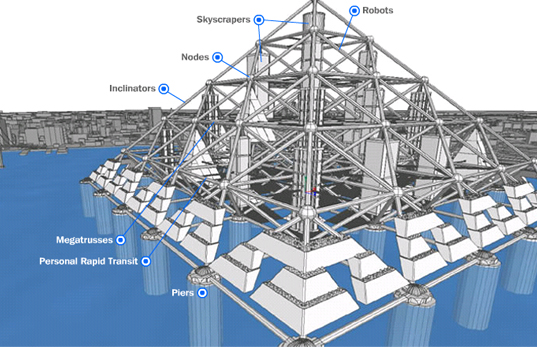
Looking eerily like Mt. Doom in the above rendering, the mountain-like X-Seed 4000 represents a utopian eco-vision for a self-contained high-rise city in the Tokyo harbor – powered mainly by solar energy. Aesthetically inspired by nearby Mt. Fuji, the behemoth building would measure 13,123 feet tall with a 6 square-kilometer footprint, and could accommodate five hundred thousand to one million inhabitants.
Designed by Taisei Construction Corporation as an “intelligent building,” the futuristically-named X-Seed 4000 would maintain light, temperature, and air pressure in response to changing external weather conditions.
El X-Seed 4000 es el edificio más grande jamas diseñado. La idea fue iniciada por Peter Neville.
El X-Seed 4000 «nunca será construido», dice Georges Binder, director general de Buildings & Data, una empresa que recopila bases de datos sobre construcciones de todo el mundo. «El propósito del plan era ganar algo de reconocimiento para la empresa, y funcionó.»
Esta propuesto que mida 4 kilómetros (4000m) de alto, 6 kilómetros (6000m) de ancho, con la base en el mar. Tendría 800 plantas que pueden acomodar entre 500 mil o un millón de personas
Fue diseñado para Tokio, Japón por la empresa japonesa «Taisei Construction Corporation» como un entorno futurístico, combinando alta calidad de vida con interacción con la naturaleza
El coste para construir este rascacielos se ha estimado entre USD$300 millardos y USD$900 millardos.
A diferencia de los demás rascacielos de Japón, el X-Seed podría requerir proteger a sus ocupantes de la presión y del tiempo debido a su gran altura.
¿Te imaginas que los arquitectos de la Roma clásica hubieran dejado los planos colgados en una red de redes para que cualquier persona del mundo los utilizara? ¿Que Gaudí hubiesen registrado los planos de La Pedrera sin copyright? ¿Cuántas ciudades habrían reciclado / remezclado el genio de los grandes arquitectos de la humanidad? En la era de la sociedad en red, la arquitectura abierta comienza a ser una realidad. La cultura de código abierto se abre paso en el hasta ahora vertical y elitista mundillo del ladrillo. Y cada vez son más los estudios que usan las licencias Creative Commons para sus obras.
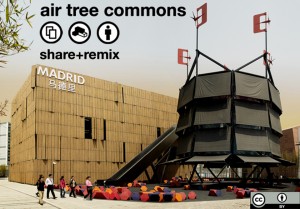
El estadounidense Cameron Sinclair, creador del proyecto Architecture for Humanity , es uno de los grandes visionarios de la arquitectura abierta. En una entrevista a la revista Wired, Cameron desmenuzada así su sueño: “Nuestro sueño es desarrollar una base de datos de diseños, clasificada por ubicación, temas ambientales y arquitectos. Bromeando la he llamado la Open Source Architecture Network. Ya estamos trabajando con Creative Commons viendo el modo de hacer que los diseños estén disponibles gratuitamente alrededor del mundo”. Un estudio importante que ya está disponibilizando sus obras con licencia Creative Commons es el madrileño Ecosistema Urbano. Su Air Tree Commons para la Expo de Shangai de 2010, fue la primera obra cuyo proceso entero fue elaborado con licencia Creative Commons. El estudio holandés OBOM es otro de los abanderados en la arquitectura abierta.
Más aún, en la universidad de la que fui profesor, participé en la redacción de pautas de aplicación para su implantación a nivel nacional (ver a continuación el documento disponible vía Scribd)
Plan del conjunto - intervención - Fuente: planetprinceton.com
Princeton University is preparing to submit plans to the Regional Planning Board of Princeton for its $300 million arts and transit neighborhood by this spring. Those plans have been modified in recent weeks, according to University officials.
The University has selected Rick Joy, a leading American architect with experience designing train stations, as the architect to design the new Dinky station building and Wawa, and renovate the existing station buildings for use as a restaurant and café.
Princeton Borough and Princeton Township approving zoning changes for the University project to move forward late last year. The zoning changes have been challenged by residents in a lawsuit.
Plans for construction of the new station and the renovation of the existing station buildings will be included in the University’s submission to the Planning Board.
Princeton University Vice President and Secretary Robert Durkee sent a letter to the planning board today updating the board on recent project developments.
“In recent weeks we have made further adjustments to accommodate specific requirements in the new zoning ordinances and to reflect both suggestions from members of the community and the more detailed design that can be done now that zoning is in place to allow us to proceed with the project,” Durkee wrote. “All of the basic elements of the plan remain: the roadway improvements, including the roundabout at Alexander and University Place; the new train station incorporating the Wawa and the associated transit plaza and parking; the driveway into the Lot 7 garage; the conversion of the existing station buildings into a restaurant and café; extensive landscaping; and, of course, the first phase arts buildings and public plaza designed by Stephen Holl.”
When entrepreneur Malcom McLean developed the intermodal shipping container in 1956, he became more than just an inventor; he became an architect. Today, when these containers aren’t moving cargo on truck, ship, and rail, they are being used for various methods of habitation: a home, office, and—in at least one case—an environmental education center.
The Los Angeles design group APHIDoIDEA is working on plans for an Environmental Center of Regenerative Research & Education (eCORRE) Complex, a place where evidence for recycling’s potential is written on the corrugated steel walls. With close proximity to the second busiest port in the world, the firm has proposed a building made from 65 shipping containers. The eCORRE complex would boast a slew of sustainable innovations including a botanical garden “green roof” and the incorporation of reusable energy sources.
“[The project] re-adapts the shipping container as core building elements and implemented sustainable strategies to educate its visitors and users about “green” building practices,” said Jesus Eduardo Magaña, a senior collaborator at APHIDoIDEA. “We separated the structure and the space design from the container itself…at the same time we utilized its two best elements: its design modularity and the durability of its material.
Through collaboration, successful architects are adapting their creative ideas and technical know-how to different cultures, climates, and disciplines. In addition, their research into the social, psychological, and biological sciences are helping them solve evolving programmatic needs.
This year’s Innovation Conference brings together design professionals who will demonstrate through specific case studies how they have effectively crossed boundaries and disciplines to increase their impact on the built environment.
View Highlights from Last Year’s Innovation Conference:
The Moscow Metro is a lesson in Russia’s history and architecture, where you can meet Lenin, Dostoyevsky and Pushkin on your travels.
As you travel on Moscow’s Metro, the history of the city’s past eight decades unfolds before your eyes.
The stations range in design, from palatial baroque marble and granite structures to modern iron and glass, revealing the tastes, ideas, hopes and disappointments of the times in which they were built.
First steps underground
The Moscow Metro dates back to 1931, when its construction began, although engineers Pyotr Balinsky and Evgeny Knorre submitted their first designs to the Moscow City Duma as far back as 1902.
The Duma, which was then made up of wealthy people, was not convinced at first: after all, they lived in the centre of the city and didn’t have to travel in the overcrowded trams. But after five failed proposals, the Duma finally approved the plans and building began.
On May 15, 1935, 18 years after the Bolshevik revolution, the Metro threw open its doors and carried its first passengers down its escalators and on to its new wagons with padded seats (unlike the uncomfortable wooden seats in trams).
Logotipo del Metro de Moscú (en ruso: Московский метрополитен)
The first Metro line – running from Sokolniki to Dvorets Sovetov (now Kropotkinskaya) – was 11km (seven miles) long and had 13 stations. The Metro now has a track of more than 300km with 12 lines and 182 stations, which vary in depth from five to 80 metres. The city plans to add another 120km of track by 2020.
The Lenin rebrand
For the first 20 years of its history, the Moscow Metro was named after Lazar Kaganovich, the “Iron Commissar” and Stalin’s right-hand man, who was in charge of construction of the first stage of the Metro (he blew up the Cathedral of Christ the Saviour in December 1931 as part of the Proletarian Capital project).
In 1955, the Metro was renamed after Vladimir Lenin. Although Russia has long since changed its political path, you can still find the images of Lenin at more than 10 stations, including busts of Lenin at Belorusskaya and Komsomolskaya stations, impressive mosaics at Baumanskaya and Kievskaya, and a tile panel in the passage between the Borovitskaya and Biblioteka Imeni Lenina.
Images of Stalin, which were omnipresent on the Metro in the late Forties, were gradually removed after his death in 1953 and the subsequent denunciation of his legacy.
Architectural eras
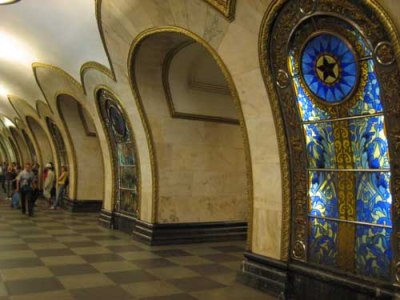
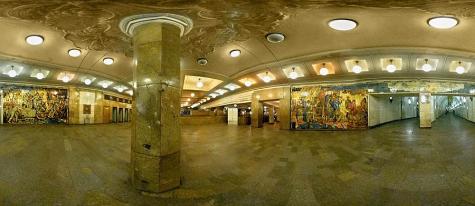
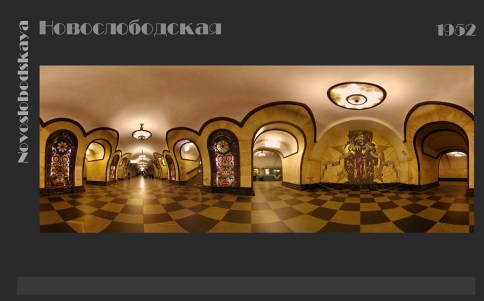
Visitas virtuales de las estaciones del Metro de Moscú - CasaRusia.com
The first Metro stations, up until the mid-Fifties, were conceived and built as luxurious “palaces for the people”, great architecture for a great state. Art historians say the richly decorated underground was a deliberate ideological move to eulogise the young Soviet country. Stations built between 1937 and 1955 are characteristic of this first architectural period.
Como se puede ver en las imágenes, las estaciones del metro de Moscú se parecen más a una galería de arte que a las terminales de un tren subterráneo. Y no se trata sólo de una estación bonita, sino que la red del metro moscovita es una gran obra de arte arquitectónica y un atractivo turístico per se.
A pocos les interesaría hacer una visita virtual por el metro de Nueva York o de Londres, sin embargo si no se tiene la oportunidad de hacerlo en persona, vale la pena conocer, al menos virtualmente, el de Moscú.
El Metro de Moscú (en ruso: Московский метрополитен) también conocido como el palacio subterráneo, fue inaugurado en 1935, es el primero del mundo por densidad de pasajeros, transporta alrededor de 3.341.500.000 personas al año y cerca de 9,2 millones de personas lo utilizan al día.2 Tiene 182 estaciones y una longitud de tendido subterráneo de 298 kilómetros (tercero en el mundo después de Londres y Nueva York) con 12 líneas.
En la línea nº 5, con forma de anillo que se cruza con todas las otras, la megafonía indica a los viajeros el sentido en que viaja el tren utilizando voces masculinas cuando avanzan en el sentido de las agujas del reloj, y voces femeninas cuando va en sentido anti-horario. En las líneas radiales, se utilizan voces masculinas cuando los trenes se acercan al centro de la ciudad, y voces femeninas cuando se alejan.
Una de las actividades turísticas habituales en una primera visita a Moscú es la visita a las estaciones de metro más llamativas. A no ser que intencionadamente te hagas la «ruta del metro», normalmente uno las va viendo según pasa por ellas de camino a otros destinos.Si este verano se presenta tu primera visita a la capital rusa, puedes echar un vistazo a los dos sitios web que te proponemos, realmente interesante, para disfrutar de fotos panorámicas y QTVR (realidad virtual) de algunas estaciones del metro moscovita, por si quieres echar un ojo a lo que te encontrarás.
El sitio web donde se puede acceder a las fotografías panorámicas:





















 Arquitectonico
Debe estar conectado para enviar un comentario.