La mitad de sus 135 viviendas -repartidas en 60 plantas- ya han sido reservadas
El Mundo | Nueva York
Recreaciones virtuales del 56 Leonard Street de Nueva York. | E.M.
El ‘56 Leonard Street‘ de Tribeca, la torre residencial más original diseñada en Nueva York en los últimos años, se pone a la venta tres años antes de su finalización. El edificio, diseñado por el estudio suizo Herzog & de Meuron(Pritzkeren 2001), renovará el ‘skyline’ de Manhattan gracias a sus 253 metros de altura, su forma irregular y su fachada acristalada.
El edificio, situado entre las calles Church Street y Leonard Street, está destinado a ser ocupado por adinerados de todo el mundo. En sus primeras tres semanas a la venta, la firma comercializadora asegura que ya ha reservado el 50% de las 135 viviendas de la torre, valoradas en 348 millones de euros. Un 70% de los compradores serían, según elNew York Times, residentes de la propia ciudad.
La torre contará con 60 plantas y ocupará una superficie total de 454.181 metros cuadrados. Las viviendas tendrán entre dos a cinco habitaciones y su tamaño oscilará entre 130 a 595 metros cuadrados.Su precio: entre 2,9 y 25 millones de euros.
Todas ellas incluirán elementos personalizados de Herzog & de Meuron, como las chimeneas esculturales del suelo al techo que ocupan la sala añaden drama y complementan el arte y mobiliario. A los balcones y terrazas privados se accede mediante puertas de vidrio.
El edificio ofrecerá 10 espectaculares áticos, compuestos por ocho viviendas en toda la planta y dos viviendas de media planta con paredes de 4,27 metros, increíbles vistas y espacios exteriores, chimeneas de madera y llegada privada en el ascensor.
Los precios oscilan entre 2.921.000 y 24.768.700 de euros. La Sales Gallery se localiza en 75 Leonard Street, entre Church y Broadway en Tribeca.
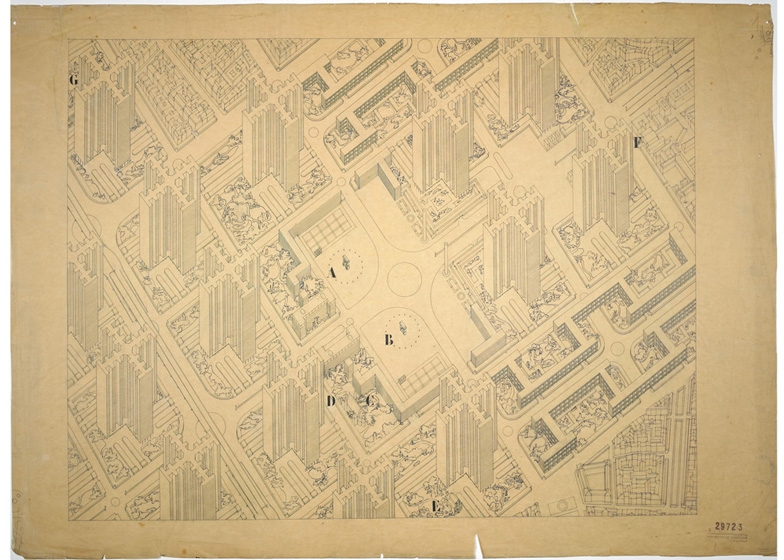
Hoy inaugura en el Museo de Arte Moderno (MoMA) en Nueva York la muestra «Le Corbusier: Atlas de Paisajes Modernos«, construida partiendo de documentos originales del genial arquitecto.
A retrospective on the life and work of Le Corbusier opens today at the Museum of Modern Art (MoMA) in New York. This selection of drawings and paintings by the architect documents the various stages of his career, as presented in the exhibition.
María G. Picatoste @pikatoust / ABC.es, Nueva Tork
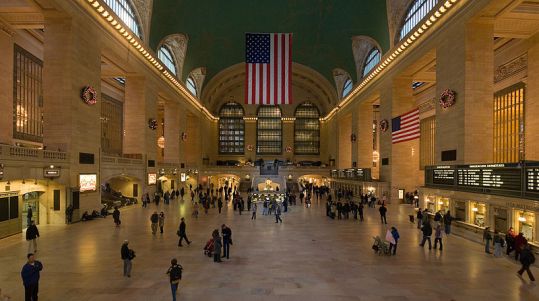
View inside the Main Concourse, facing east – Wikipedia
La terminal Grand Central de Nueva York celebra sus primeros 100 años con un nutrido calendario de festejos y haciendo memoria de su excelsa historia.
En los albores del siglo XX, la ciudad de Nueva York fue testigo de un truculento accidente. A primera hora de la mañana del 8 de enero de 1902, un tren exprés procedente de White Plains embistió a otro tren que se encontraba detenido en el túnel de Park Avenue a la espera de recibir la señal de acceso a la estación central de Nueva York. El suceso, en el que fallecieron 15 personas y causó decenas de heridos, provocó que la opinión pública exigiese la reforma del túnel de la vieja vía.
El percance fue el germen de un ambicioso proyecto que acabó dando a luz a la majestuosa terminal de Grand Central, la icónica estación que ocupa el centro neurálgico de Manhattan y que hace las veces de corazón de la metrópoli, bombeando cada día a la ciudad millones de pasajeros.
Perforated aluminum screens now enclose the balconies of the Elmer Holmes Bobst Library at New York University, where three students have leapt to their deaths since 2003. The N. Y. Times
“One of New York’s most spectacular architectural experiences,” Paul Goldberger, then the architecture critic of The New York Times, wrote in 1973 about the atrium of the new Elmer Holmes Bobst Library at New York University. It was that, indeed.
It also proved to be one of the most unnerving. The thin aluminum balusters ringing the balconies of the 12-story structure seemed disquietingly insubstantial against the 150-foot-high void beyond.
When seen from above, the trompe-l’oeil floor looked like a three-dimensional fantasy landscape by M. C. Escher that almost beckoned the viewer to enter. A journey through Bobst could feel precarious even on the best day.
And there were three dreadful days. On Sept. 12, 2003, John D. Skolnik, a junior, jumped to his death in the atrium. Less than a month later, on Oct. 10, so did Stephen Bohler, a freshman.
Within weeks, the university installed eight-foot-high clear polycarbonate barriers along the balconies. Despite this measure, on Nov. 3, 2009, Andrew E. Williamson-Noble, a junior, also jumped to his death there.
One step the university took in response to these and other student deaths was to commission Joel Sanders Architect to reimagine the troublesome space in Bobst. Instead of trying to create an inconspicuous barrier, Mr. Sanders and his colleagues have designed randomly perforated aluminum screens that completely enclose the balconies around the perimeter of the atrium and the open staircase connecting them, transforming the space in consequence.
University officials expect the renovation to be finished next month. They would not disclose the cost.
(33) Architect focused on modern design – Interested in all things creative – Love to help non-architects learn about architecture. @modative principal + co-founder. http://www.modative.com
(42) Architect, futurist, urban designer, rhetorician, adjunct prof, treehugger, former biz owner now a writer/analyst exploring city futures, reborn from @cindyfw.
The BMW Guggenheim Lab is a mobile laboratory traveling to nine major cities worldwide over six years. Led by international, interdisciplinary teams of emerging talents in the areas of urbanism, architecture, art, design, science, technology, education, and sustainability, the Lab addresses issues of contemporary urban life through programs and public discourse. Its goal is the exploration of new ideas, experimentation, and ultimately the creation of forward-thinking solutions for city life.
Over the Lab’s six-year migration, there will be three distinct mobile structures and thematic cycles. Each structure will be designed by a different architect, and each will travel to three cities around the globe. The theme of the Lab’s first two-year cycle is Confronting Comfort—exploring notions of individual and collective comfort and the urgent need for environmental and social responsibility.
The BMW Guggenheim Lab launched in New York, running from August 3 to October 16, 2011. It is currently in Berlin, where it will be open through July 29, 2012, before moving on to Mumbai in late 2012. Cycle 1 will conclude with an exhibition presented at the Solomon R. Guggenheim Museum in 2013. Two additional two-year cycles will follow, each with a new mobile structure and theme, concluding in the fall of 2016.
Part urban think tank, part community center and public gathering space, the Lab is conceived to inspire public discourse in cities around the world and through the BMW Guggenheim Lab website and online social communities.
The public is invited to attend and to participate in free programs and experiments at the Lab. In addition, the BMW Guggenheim Lab website and social communities provide opportunities for participants around the world to engage with and to contribute to the ideas and experiments generated by the Lab.
Esta caja de herramientas itinerante y multidisciplinar, que se podra visitar en la capital alemana hasta el 29 de junio, abarca urbanismo, arquitectura, arte, diseño, ciencias, tecnología, educación y sostenibilidad
JOSE-PABLO JOFRÉ / CORERSPONSAL EN BERLÍN – ABC.es
Kreuzberg no se quiere aburguesar; los hipsters pertenecen a otros barrios berlineses. Así justificaron los vecinos del barrio donde originalmente quería instalarse la estructura itinerante del proyecto«BMW Guggenheim Lab» de la fundación neoyorkina Guggenheim. Así que ha aterrizado finalmente en Prenzlauer Berg, en una antigua nave industrial del sector este de la ciudad, reconvertido en centro multiusos. Esta es la razón que el BMW Guggenheim Lab haya retrasado hasta el 15 de junio y por más de tres semanas la inauguración de este laboratorio móvil de ideas en la capital alemana.
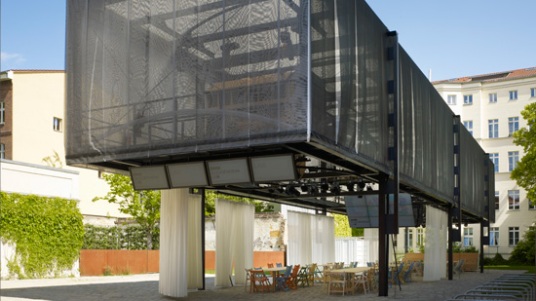
Exterior view; Photo: Christian Richters
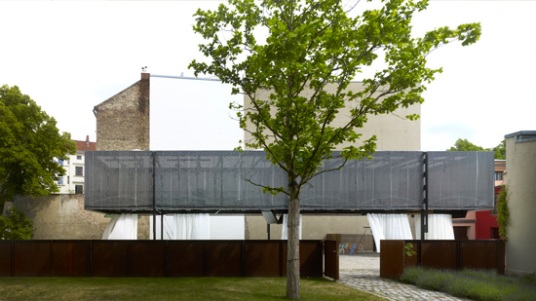
La estructura que acaba de abrir sus puertas y que comenzó su recorrido en Nueva York, es un armazón de fibra de carbono diseñada por el despacho de arquitectos Bow-Wow de Tokio como una«caja de herramientas itinerante». Permanecerá en Berlín hasta el próximo 29 de julio, tras lo cual continuará su viaje a Bombay.
Lightweight and compact, with a structural skeleton built of carbon fiber, the mobile structure for the first cycle of the BMW Guggenheim Lab has been designed by the Tokyo architecture firm Atelier Bow-Wow as a “traveling toolbox.”
The structure’s lower half is a present-day version of the Mediterranean loggia, an open space that can easily be configured to accommodate the Lab’s various programs. The upper part of the structure houses a flexible rigging system and is wrapped in a semitransparent mesh. Through this external skin, visitors are able to catch glimpses of the extensive apparatus of “tools” that may be lowered or raised from the canopy according to the Lab’s programming needs, transforming the ground space into a formal lecture setting, a stage for a celebratory gathering, or a workshop with tables for hands-on experiments.
Design Architect
Atelier Bow-Wow, Tokyo, Japan
Principals: Yoshiharu Tsukamoto and Momoyo Kaijima
Project Team: Mirai Morita and Masatoshi Hirai
Fabrication and Structural Engineering
Superstructure and Installation: NUSSLI Group, Switzerland/USA
Structural Engineer: Arup, Tokyo, Japan
Berlin Design, Engineering, and Construction
Local Architect: magma architecture, Berlin, Germany
Structural and Civil Engineer: Arup, Berlin, Germany
Construction Management: NUSSLI Group, Switzerland/USA
New York Design, Engineering, and Construction
Architect of Record: Fiedler Marciano Architecture, New York, USA
Structural and Civil Engineer: Arup, New York, USA
Site Preparation Construction Management: Sciame Construction Co., New York, USA
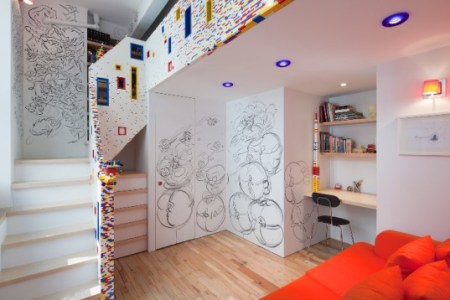
When the son of Melissa Marks and Vicente Caride got too old not to have a door on his bedroom, they decided it was time to make some renovations to their New York loft apartment. So they called in I-Beam Design for help, and together with LEGO artist Sean Kenney, they built a new stair railing and wall out of 20,000 LEGO bricks. Colorful, flexible, and very fun, this renovated space beautifully showcases everyone’s favorite building block.
Using mostly primary colors, the kid’s room is minimal and playful. I-Beam designed the 20,000 LEGO blocks staircase, while artist Sean Kenney worked with the family to create a pleasant flow of receding or intensifying color up and down the stairs. The apartment’s color palette offers a soft background for the LEGO-inspired touches of colors and the iconic furniture — like the Barcelona Chair — placed throughout the space.
The stark kitchen was made using another Nordic classic, IKEA cabinets, and features splashes of colors like the Blu Dot red chairs and shiny blue backdrop. Sliding walls also serve as exhibition walls to reveal or conceal different areas of the house, like the modern looking dinning room. Playful, colorful, modern and very arty, this wonderful New York apartment shows that LEGOs are good for much more than child’s play.
El último proyecto del estudio holandés son dos torres en Corea del Sur que se unen mediante un volumen calado de diez niveles a la altura del piso 26. Reubicar el basamento y liberar la planta baja.
De noche. La nube se recorta contra el perfil urbano de Seúl (Gentileza MVRDV). Arquitectura Clarín.com
A la entrada del Yongsan Dreamhub, una urbanización ubicada en el distrito comercial de Seúl, se erigirá el último proyecto de MVRDV. La nube es un complejo de dos torres unidas en su piso 26 por un volumen de diez niveles, y es un ejemplo de cómo los intereses teóricos del estudio holandés encuentran un lugar dentro de su obra construida. En este caso, su búsqueda se orienta en dos direcciones: cómo generar espacios más amplios y variados al nivel de la calle y cómo producir alteraciones a la tipología tradicional de la torre en altura. Fue así que decidieron materializar las funciones que generalmente se desarrollan en el basamento en un bloque a más de 100 metros de altura, liberando la planta baja para que la paisajista inglesa Martha Schwartz diseñe un jardín urbano, una adición a la ciudad y a los peatones.
Las torres no son iguales en altura: una mide 260 metros y tiene 54 pisos, mientras que la otra alcanza los 300 metros con 60 pisos. Los departamentos varían en superficie desde los 80 m2 hasta los 260 m2, todos con acceso desde el lobby. Al tener una planta cuadrada, las unidades se ubican en los cuatro vértices, asegurando ventilación cruzada y una amplia cantidad de luz para todos los locales. Mediante ascensores exprés se accede desde la planta baja al volumen transversal, donde a lo largo de diez niveles se puede ubicar un gimnasio y un centro de convenciones, como así también varias piletas, restaurantes y cafés.
Hay quien, ante la imagen superior, se retrotrae a los atentados del 11-S en Nueva York, en el momento en que las Torres Gemelas explotaron por el impacto de los aviones.
Un malentendido que ha suscitado polémica entre internautas, especialmente en Estados Unidos, y que ha llevado a pedir disculpas al estudio de arquitectura responsable de este proyecto, titulado ‘The cloud of Knoweledge‘ (‘Nube del conocimiento‘) porque eso es lo que dicen que les inspiró.
El estudio holandés MVRDV añade que el polémico diseño responde a la vocación de esta firma por experimentar con «Ciudades elevadas» para «reinventar» el concepto de rascacielos.
Y remite a la imagen de la derecha – la de la nube que cubre el centro de unos rascacielos -, también colgada en su web, como parte de su proyecto, para justificar que fue se ideó «basándose en parámetros como la luz del sol, los espacios abiertos y la calidad de vida para los habitantes de ciudades».
«Ni fue nuestra intención crear una imagen que se asemeja a los ataques ni nosotros hemos percibido esa semejanza durante todo el proceso de diseño. Mostramos nuestras más sinceras disculpas a todos aquellos cuyos sentimientos hayamos herido porque no era nuestra intención», señalan.
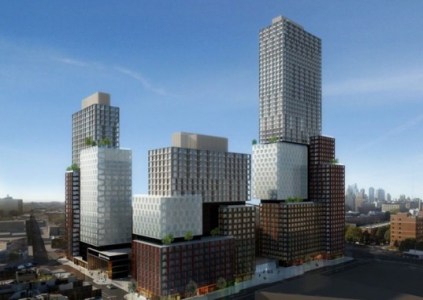
The renderings for the massive modular complex for Brooklyn’s Atlantic Yard were revealed Friday by Forest CityRatner Developments. Designed by SHoP Architects, the 32 storey building will be the world’s tallest prefab and will look like stacks of volumes akin to a college campus. Although the prefab project will save on both cost and waste, the initially promised 17,000 jobs it would create has been somehow reduced to a paltry 190, amongst other disappointments.
Around 60% of the modular complex will be prefabricated, which will cut down on congestion, noise and pollution from the construction site. But what it also cuts down on is the promised union worker’s wages- from $85 an hour on the construction site to $35 in the less dangerous factory site, not to mention the aforementioned fewer jobs than initially proposed.
Another discrepancy from the 2006 plan is the size of the affordable housing apartments. The new construction report announced 130 studios, 180 one bedrooms and 20 two bedroom apartments, which differs from the original claim that 50% of the units would be 2 or 3 bedroom apartments. A percentage of each will still become affordable rental housing, but larger families counting on calling the new Atlantic Yards home will have to look elsewhere.
¿Cuál es el fin de la arquitectura? Conforme el diseño y la construcción avanzan, son más los arquitectos que intentan desmarcarse de las clásicas ideas de urbanismo o edificación. Si hasta hace unos años lo importante era que un edificio o una vivienda llamara la atención y se hablara de ella ahora el minimalismo se impone a la ostentación.
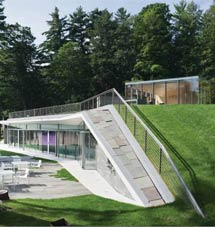
Éste es el caso del arquitecto Peter Gluck que ha conseguido que su proyecto situado junto al lago George, en las montañas de Adirondack, en Nueva York, se camufle con el medio que lo rodea. En esta particular vivienda, de alrededor de 6.600 metros cuadrados hay espacio para vivir, para pernoctar y para disfrutar de los momentos de ocio. Porque esta atípica casa del lago cuenta, además de con un gran espacio verde exterior, de varias terrazas y patios así como una piscina.
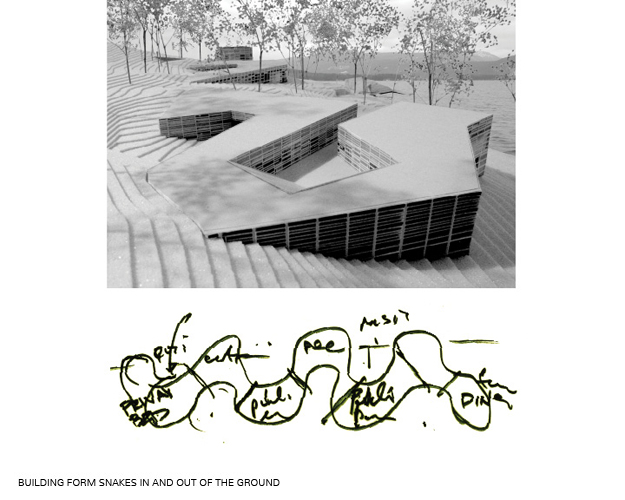
En este proyecto, del que se ha hecho eco Architectural Record , Peter Gluck ha dividido la construcción en dos partes. Por un lado, está la oficina, en la parte superior de la construcción y, ‘bajo tierra’, la vivienda en sí y una zona para los momentos de relax que cuenta, además de con una larga piscina, con un anfiteatro, un gimnasio y una sauna. Además, la vivienda cuenta con casa de invitados y largos caminos donde perderse entre los árboles del parque de Adirondack (Nueva York).
Lakeside Retreat Peter Gluck and Partners Adirondack Mountains, New York Image courtesy Peter Gluck and Partners - Architectural Record
Adirondack Mountains, New York
Peter Gluck’s modern take on the Adirondack Great Camp with two landform buildings that become part of the scenery.
Some minimalist architects boast that given enough money, they can make their architecture almost disappear. Although that claim seems to go against normal expectations about what so many architects really like to do, it often tempts those faced with a large program and a sensitive site.
“Los arquitectos seleccionados son aquellos que han logrado carreras en sus respectivos países y que han sido internacionalmente reconocidos por sus esfuerzos”, explicó Julio Martínez, uno de los curadores asistentes de la exposición, que contará con trabajos de 10 países.
Organizada por la Escuela de Arquitectura del Instituto Pratt, la exhibición fue inaugurada el fin de semana pasado y permanecerá abierta hasta el próximo 30 de noviembre en la galería Robert H. Siegel, en el condado de Brooklyn.
La exhibición está dividida de acuerdo con las regiones geográficas en América Latina y mostrará las contribuciones de arquitectos contemporáneos al beneficio de sus sociedades mediante la construcción del entorno.
“El objetivo de la muestra es presentar e investigar América Latina como un lugar de gran significado histórico y de recientes desarrollos en arquitectura y paisaje urbano”, declaró Andrés Chávez, otro de los curadores de la exposición.
























 Arquitectonico
Debe estar conectado para enviar un comentario.