
Helsinki, diseño y urbanismo para crear la ciudad del futuro – 20minutos.es – Capital Mundial del diseño en 2012


  • La capital de Finlandia será Capital Mundial del diseño en 2012.
  • Helsinki va cambiando los acartonados edificios de estilo soviético por otros eco-sostenibles y de refinado diseño.
  • En la zona de Punavuori se apiñan 190 tiendas, galerías y estudios.
  • Arabianranta, con 15.000 vecinos, es la ciudad del arte y el diseño.

DTLux.

Helsinki- Punavouri es el barrio del diseño finés (Flickr / IK´s World Trip - 20minutos.es)

Helsinki, la capital de Finlandia, es atractiva desde muchos puntos de vista. Esta vez nos referimos a uno muy concreto: el diseño. Y es que la ciudad será Capital Mundial del diseño en 2012.

El nombramiento supone la organización en la región de Helsinki, de una amplia gama de actividades dentro del campo del diseño, al mismo tiempo que una visibilidad internacional considerable.

Como relata DTlux, Helsinki está cambiando hacia un nuevo concepto de ciudad. Desde principios de 2009 la capital finlandesa está mudando de piel y lo hace a gran velocidad, dejando atrás los acartonados edificios de estilo soviético y sustituyéndolos por otros eco-sostenibles, luminosos y, ante todo, fruto del refinado diseño finlandés.

Urbanismo y diseño

Ahora, la ciudad planea una reestructuración de toda su planta arquitectónica, un ambicioso proyecto que culminará en 2030. El trazado incluye la creación de canales artificiales que rieguen la urbe (ya de por sí situada en un fiordo) y la reutilización de los 20 km de costa portuaria.

Helsinki será capital del diseño el año que viene, y lo será por algo. En un puñado de calles de la zona de Punavuori se apiñan 190 tiendas, galerías, estudios y bares que desbordan creatividad.
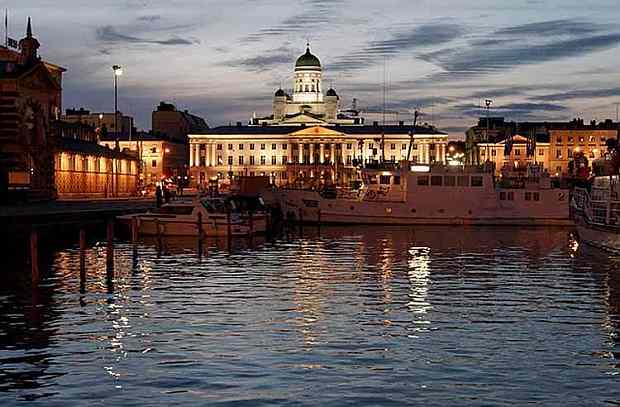
Helsinki - Anochecer, con la catedral al fondo. (FLICKR / Ilpo Torn - 20minutos.es )

Tres direcciones muy recomendables son Artek, la gran marca finesa de muebles mezcla arte con tecnología, gTIE, cuyas corbatas son enormemente provocadoras, y Kokoro & Moi, el estudio de diseñadores que revoluciona la ciudad. A su cargo corre la tarea de cambiarles la cara a los transportes de Helsinki: hasta los billetes de tranvía son de diseño.

vía Helsinki, diseño y urbanismo para crear la ciudad del futuro – 20minutos.es – El medio social.

Helsinki prepara sus celebraciones como Capital Mundial del Diseño 2012

Helsinki - Capital Mundial del Diseño 2012

Después de su nombramiento como Capital Mundial del Diseño 2012Helsinki se encuentra en plenas preparaciones para comenzar su año como ciudad líder en el mundo del diseño. 

Helsinki comenzará el año con una ceremonia donde celebrará su nombramiento y presentará su calendario de más de 300 actividades relacionadas con el diseño bajo el lema «Helsinki abierta – el diseño incorporado a la vida».

Helsinki, elegida Capital Mundial del Diseño 2012

Helsinki será la Capital Mundial del Diseño en 2012.

Así lo ha decidido el Consejo Internacional de Sociedades de Diseño Industrial (ICSID), que anunció su decisión en el Congreso de Diseño celebrado en Singapur el 25 de noviembre.

“Esto es algo muy importante tanto para Helsinki y las ciudades colaboradoras, Espoo, Vantaa, Kauniainen y Lahti, como para las numerosas organizaciones e individuos que se han involucrado en el proyecto. Hemos conseguido una oportunidad excepcional, a la cual tenemos que sacar todo el partido posible”, afirma el alcalde de Helsinki, Jussi Pajunen.

Un total de 46 ciudades de 27 países distintos compitieron para convertirse en Capital Mundial del Diseño. Un jurado internacional eligió Helsinki y Eindhoven como finalistas, concediéndosele el honor a la capital finlandesa tras una estricta evaluación.

World Design Capital – Capital Mundial del Diseño

hotel.info

Arquitectura tecnológica – Faro de Vigo (Sobre MirrorCube de TreeHotel, Suecia)


farodevigo.es » Tecnología

Las nuevas tecnologías permiten a los estudios de arquitectura crear auténticas obras de arte arquitectónicas.

Imagen del cubo espejo www.mirrorcube.se - Faro de Vigo
Imagen del cubo espejo http://www.mirrorcube.se - Faro de Vigo

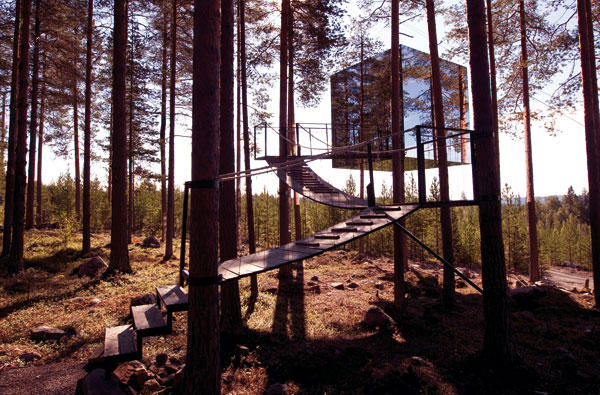
Inspirados por la película The Tree Lover – Trädälskaren (2008), del director Jonas Selberg, la empresa sueca Treehotel inició hace algún tiempo un proyecto que puede cambiar el futuro de la arquitectura. El Mirrorcube –»Cubo de espejo«, 277.000 €– es ni más ni menos que un cubículo construido con los más modernos materiales – y los más clásicos, como la madera – para conseguir así un efecto único. En un entorno totalmente natural se emplazan estos cubos habitables que destacan por estar recubiertos de un cristal especial fabricado con la última tecnología que permite aislar del ruido y la climatología el interior del habitáculo.

Al tratarse de un material tipo ´espejo´ todo el entorno se refleja en la superficie de la estancia, con lo que no produce ningún impacto paisajístico.

Complejas fórmulas matemáticas realizadas con súper ordenadores han posibilitado el uso de cables de acero que sujetan cada uno de estos futuristas cubos para así poder aguantar sin problemas cualquier inclemencia climatológica.

vía Arquitectura tecnológicaFaro de Vigo.

TREEHOTEL introduces MIRRORCUBE – Your link to Nature

Web de Treehotel (Suecia)

* – * – * – * – *

La noticia de hoy en ArquitecturaS (vía Twitter@darioalvarez

https://twitter.com/#!/darioalvarez/status/135376031870758913

Architect Cymon Allfrey Honoured : Architect honoured for home design – business | Stuff.co.nz


A Christchurch house was last night announced as the nation’s best architectural design.

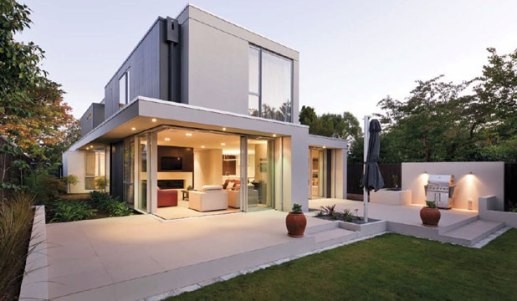
AWARD-WINNING: Architect Cymon Allfrey, below, and his winning design. www.stuff.co.nz
AWARD-WINNING: Architect Cymon Allfrey, below, and his winning design. http://www.stuff.co.nz

Cymon Allfrey was named supreme winner at the Architectural Designers NZ / Resene National Design Awards gala dinner held at Te Papa for his design of  «Leinster House«.

The Christchurch architect designed the «modest, contemporary home» in Merivale to accommodate the daily needs of a couple, and to also be spacious enough to handle the expected return of their adult children.

Judges described the house as «beautifully composed» with an «exemplary relationship to its garden».

«Still and orderly, this reflects the great skill and control of its designer.»

The suburban home is set in a «gardened» street and Allfrey took that into consideration by setting the home back from the road.

The house has a central entrance into a gallery that becomes two levels in height and serves as the hub of the home.

The gallery is designed to allow sun from the east into the kitchen, and passive ventilation through a thermal chimney means the home does not need air-conditioning.

Interior - Leinster House vía primedesign.co.nz

The main living spaces are in the north of the home. The secondary sleeping and living rooms are at the first-floor level, which serves as a second apartment.

Other winners included Tony Biesiek from Imagine Building Design, who took out a joint win of the residential Alterations and Additions Design Award for The Pepper House in New Plymouth. Biesiek’s design was praised by judges for its «unobtrusive commitment to sustainable design».

vía Architect Cymon Allfrey Honoured – business | Stuff.co.nz.

ADNZ – Architectural Designers New Zealand

Leinster House primedesign.co.nz

Imagine Building Design

Sketching Out a New Course for Architects – WSJ.com


Culture City

Ramin Talaie for The Wall Street Journal - Student Peter Spalding works on designs at the Beaux-Arts Atelier, which emphasizes the importance of knowing how to draw and paint the elements of classical architecture

Two blocks from the stately columns, arches and sculptures of Grand Central Terminal, a rogue band of architects is engaged in a retrograde venture: They’re teaching a new generation how to draw and paint the elements of classical architecture — all those columns, arches and sculptures — with nothing more than pencils and paints on paper. No computers. Ever.

«If you don’t understand the tradition profoundly, you can’t turn it on its head,» said the program’s director, Richard Cameron.

The Beaux-Arts Atelier, a one-year program inaugurated in September, is run by the Institute of Classical Architecture and Art, a 20-year-old nonprofit devoted to keeping the classical tradition alive. Located on West 44th Street between Fifth and Sixth avenues—a block lined with such notably classic facades as the New York Yacht Club and the Harvard Club—the Institute houses both the Beaux-Arts Atelier and the Grand Central Academy of Art, a four-year art school founded in 2006 with a focus on methods taught from the 15th to 19th centuries.

The Beaux-Arts Atelier has capacity for just 12 students. The inaugural class includes eight pioneers (some applicants deferred for next year) who will study an academic, figurative method that has its roots in the Ecole des Beaux-Arts, the French school of art and architecture that dates to the 17th century. Their courses, taken in five six-week terms, will include Geometry and Proportion, Study of New York Buildings, and Drawing and Drafting. They’ll learn how to draw and sculpt the human form from instructors within the Grand Central Academy of Art.

While a formal architecture degree takes years to obtain and trains students to design buildings, this one-year program teaches them how to be artists, with a working knowledge of classical forms, in the service of design. Though this was once standard training in architecture, it began to recede from academia as the modernists of the early 20th century rejected it.

«The Bauhaus and its followers thought it was a terrible way to train. They systemically got rid of it,» said Mr. Cameron. «In addition, they indoctrinated their students to believe that it was a bad thing.»

vía Sketching Out a New Course for Architects – WSJ.com.


Architects and Designers View Sustainability as Important but Question Viability of Manufacturers’ Claims – MarketWatch


Research reveals sustainable projects are on the rise; cost is potential prohibitive factor.

red box project
Red Box Project por Jeremy Levine Design - http://www.jeremylevine.com, en Flickr

BALTIMORE, PRNewswire via COMTEX/ — The majority of architects and interior designers, 87% and 86% respectively, acknowledge that they are concerned with how products are manufactured with regard to sustainability, according to new research released today by IMRE. The research showed that the number of sustainable projects performed by architects and interior designers is projected to rise in the next year, and that sustainable products are often associated with higher cost.

These are some of the results released from the survey in which 812 architects and designers responded to an online survey fielded between September 19 and 23, 2011. The survey was spearheaded by IMRE, a full-service marketing agency specializing in the Home & Building industry, in conjunction with the American Institute of Architects (AIA) and the American Society of Interior Designers (ASID).

Doubts are cast on manufacturer claims about sustainable products.

The way architects and interior designers view manufacturers’ claims that their products are sustainable reveals that brands need to re-focus their marketing efforts to make their claims more convincing.

While most architects and interior designers pay careful attention to manufacturers’ sustainability claims, both are similarly skeptical when asked if they are confident that products referred to as «sustainable» actually are.

40% of architects and 34% of interior designers are «uncertain» if products claiming to be sustainable are actually sustainable.

USACE builds sustainable distribution center for DLA
Construction nears completion July 28, 2011, on the 250,000-square-foot Logistics Distribution Center for Defense Logistics Agency Distribution Europe, headquartered in Germersheim, Germany .

Almost 22% of architects and 11% of interior designers are «somewhat» or «not at all confident» that products are actually sustainable.

Only 2% of architects and 3% of interior designers are «completely confident» in manufacturers’ claims that products are actually sustainable.

vía Architects and Designers View Sustainability as Important but Question Viability of Manufacturers’ Claims – MarketWatch.

* – * – * – * – *
La noticia de hoy en ArquitecturaS (vía Twitter@arquitectonico

https://twitter.com/#!/arquitectonico/status/121158177386541056

El primer edificio móvil del mundo está en Finlandia | Vivienda | elmundo.es


INTERNACIONAL | Bloque de oficinas

  • La firma Neapo Oy es la responsable de esta construcción de paneles de acero
  • El inmueble, de tres plantas y 220 toneladas, está en la isla de Hirvensalo
  • Los dueños quieren mudarse a otro solar cuando termine el contrato de alquiler

Efe | Helsinki

ABC - EFE, Imagen del edificio en Finlandia

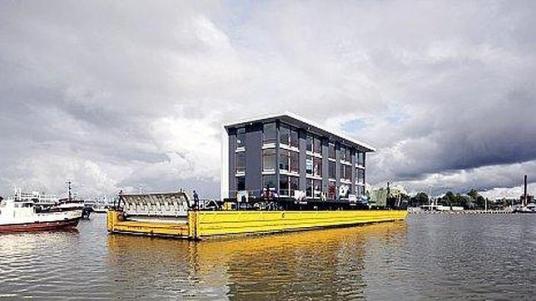
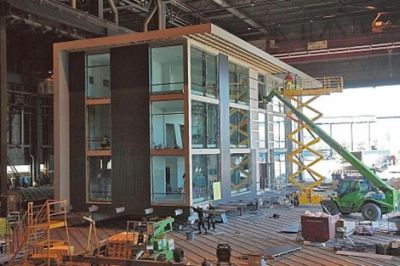
La compañía finlandesa Neapo Oy ha construido el primer edificio móvil del mundo, un bloque de oficinas de tres plantas y 220 toneladas de peso cuyo primer emplazamiento será la isla de Hirvensalo, en el archipiélago de Turku (suroeste de Finlandia).

El edificio, de 33 metros de largo, 12 de ancho y 12 de altura, ha sido transportado en una barcaza desde los astilleros STX de Turku, donde se ha construido, hasta un solar en alquiler junto al mar, donde lo han depositado con ayuda de una grúa.

Una vez que termine el contrato de alquiler, los propietarios tienen intención de mudar el edificio a una nueva localización, que también deberá estar próxima a la costa, ya que sus dimensiones hacen imposible transportarlo por carretera.

Paneles rígidos, ligeros y económicos

La estructura de este peculiar edificio de 864 metros cuadrados está formada por unos paneles de acero especiales patentados por la compañía constructora, que, según sus responsables, destacan por ser un material muy resistente, rígido y ligero, además de relativamente barato.

vía El primer edificio móvil del mundo está en Finlandia | Vivienda | elmundo.es.

EN FINLANDIA - Una compañía finlandesa construye el primer edificio móvil del mundo. Republica.com / EFE

ARTE – Cultura

Construyen en Finlandia el primer edificio móvil del mundo

Un bloque de oficinas de tres plantas y 220 toneladas de peso cuyo primer emplazamiento será la isla de Hirvensalo, en el archipiélago de Turku.

EFE / HELSINKI
Finlandia

El primer edificio móvil del mundo – Clarín.com

Lo construyeron en Finlandia. Tiene 864 metros cuadrados cubiertos distribuidos en tres pisos y pesa 220 toneladas. Su primer emplazamiento será en una isla. Cuando termine el alquiler, los dueños podrán llevarlo a otra parte.

EN FINLANDIA

  • Una compañía finlandesa es la responsable de esta construcción de paneles de acero
REPÚBLICA/EFE | HELSINKI

Construyen un edificio «móvil» en Finlandia

La estructura es un bloque de oficinas de tres plantas. Fue trasladado hoy a bordo de una barcaza.

por EFE

* – * – * – * – *
La noticia de hoy en ArquitecturaS (vía Twitter@arquitectonico

https://twitter.com/#!/arquitectonico/status/112512084989841410


Bertrand Goldberg: Architecture of Invention at the Art Institute of Chicago | canadianarchitect.com


Bertrand Goldberg´s sketch - www.canadianarchitect.com
Bertrand Goldberg´s sketch - http://www.canadianarchitect.com

The Art Institute of Chicago has organized a landmark exhibition exploring the work of Bertrand Goldberg (1913-1997), one of the most innovative modern American architects. On view from September 17, 2011 through January 15, 2012 in the Modern Wing’s Architecture and Design Galleries (283-285), Bertrand Goldberg: Architecture of Invention is the first comprehensive retrospective of the architect’s work, featuring more than 100 original drawings, models, and photographs, as well as significant examples of his rarely-shown graphic and furniture design. Long recognized for his seminal contributions to the built environment of Chicago, most notably his groundbreaking design for Marina City (1959-67), this exhibition showcases his progressive vision, dramatic architectural forms, and inventive engineering with a wide range of built and experimental projects. As a tribute to Goldberg’s career, the Art Institute has specially commissioned a stunning installation by John Ronan Architects and graphic design firm Studio Blue.

Born in 1913 in Chicago, Goldberg began studying architecture in 1930 at Harvard College. In 1932, he moved to Germany to take courses at the Bauhaus in Dessau, before relocating to Berlin to apprentice in the office of architect Ludwig Mies van der Rohe. After his return to the United States in 1933, Goldberg worked for Chicago Modernist George Fred Keck while studying engineering at the Armour Institute of Technology (now the Illinois Institute of Technology). Goldberg established his own firm in 1937 with a range of innovative work in housing and industrial design before devoting his practice to large-scale urban projects. His architectural achievements were recognized with numerous professional awards: in 1966, Goldberg was elected to the College of Fellows of the American Institute of Architects, and in 1985 he was awarded the Officier de l’Ordre des Arts et des Lettres by the French government. During his lifetime, his work served as a touchstone for a generation of international architects and critics including Reyner Banham, the Japanese Metabolist group, and members of the British architectural collective, Archigram. Today, Goldberg’s pioneering cross-disciplinary approach resonates with the diverse practices of contemporary architects and designers.

Marina City, Chicago - Wikipedia
A young Bertrand Goldberg in his Chicago office, 1950s. www.bertrandgoldberg.org
A young Bertrand Goldberg in his Chicago office, 1950s. http://www.bertrandgoldberg.org

Bertrand Goldberg: Architecture of Invention draws on the important holdings of the Art Institute’s Bertrand Goldberg Collection and Archive, which includes more than 30,000 drawings and models spanning the architect’s career from the 1930s to the 1990s. This rich archival collection was given to the Art Institute in 2002 by the Goldberg family, and includes such seminal projects as Marina City, River City (1972-89), and the Health Sciences Center in Stony Brook, New York (1965-76). This work is complemented by early student Bauhaus drawings borrowed from the Harvard Art Museums and furniture from the Goldberg family’s private collection, which makes its public debut in this exhibition.

vía Bertrand Goldberg: Architecture of Invention at the Art Institute of Chicago | canadianarchitect.com.

Reseña de la Exposición «Bertrand Goldberg: Architecture of Invention» en la Web del Instituto de Arte de Chicago.

Two (make that three) Bertrand Goldberg exhibitions to open in mid-September

Bertrand Goldberg Archive

* – * – * – * – *
La noticia de hoy en ArquitecturaS (vía Twitter@arquitectonico

https://twitter.com/#!/arquitectonico/status/104981273017200641


Experimenta Design 11 (Lisboa, Portugal)


Experimenta Design 11

Dedicado al diseño, la arquitectura y la cultura contemporánea, el ExperimentaDesign bienal presenta actividades con una amplia selección de áreas incluido diseño ambiental, arquitectura, artes visual, cine, diseño gráfico, diseño industrial, fotografía, multimedia, música y vídeo.

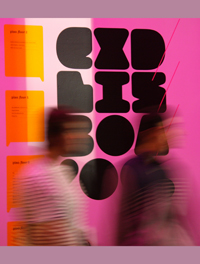
A EXD’11 tem início a 28 de Setembro. Useless é o tema proposto, incentivando à discussão e reflexão sobre (pré)conceitos ligados à utilidade e sua ausência.

www.experimentadesign.pt

Experimenta is a knowledge production unit operating in design, architecture and design culture.

Experimenta’s field of action is contemporary cultural production, observed from an inclusive, multidisciplinary and transversal perspective. Experimenta’s activity combines critical thinking, concept development and creative up-to-dateness, resulting in a consistent and incisive intervention in the social, cultural and economic contexts it engages.

Based in Lisbon, the Portuguese capital, Experimenta has achieved international projection through the development of high-profile projects, as well as the partnerships and collaborations established with a network of institutions, agents and creative practitioners from all over the world.

EXD'11/LISBOA @exdbiennale

Strongly committed to innovation and open to new challenges and contributions, Experimenta is an enterprising work and discussion platform which views culture as a key element for sustained development in contemporary society.

vía Experimenta Design 11.

@exdbiennale EXD’11/LISBOA 

Follow us for updates here on #twitter#exd11 MT @arquitectonico: EXD’11/LISBOA — USELESS – goo.gl/Az8Zy 28-09 al 27-11-2011

* – * – * – * – *
La noticia de hoy en ArquitecturaS (vía Twitter@arquitectonico

https://twitter.com/#!/arquitectonico/status/104593285267472384

hotel.info
Buscar y Reservar Hotel en Lisboa

«Los políticos destrozan las ciudades con su ignorancia»: William Curtis – Faro de Vigo


William CurtisCrítico e historiador de la arquitectura

«La generación de imágenes por ordenador conduce a veces a una arquitectura sin rigor, a una serie de geometrías sin significado»

Crítico e historiador de la arquitectura William Curtis

William Curtis (Inglaterra, 1948) es autor de la obra «La arquitectura moderna desde 1900» (Phaidon), una de las biblias de la profesión. El controvertido crítico vive en el Midi francés y es un enamorado de España y de la obra del arquitecto gallego Alejandro de la Sota. Curtis alaba la arquitectura respetuosa con el entorno y la topografía y denosta los proyectos «icónicos y con presupuestos desorbitados».

ISABEL BUGALLAL – A CORUÑA

–Es muy crítico con la arquitectura actual, ¿qué considera buena arquitectura?

–Eso es demasiado general.

–Critica la arrogancia y el narcisismo de ciertos arquitectos.

–De los que solo se preocupan por la imagen, la imagen y la imagen. Últimamente se ha hecho demasiado énfasis en una arquitectura icónica, con presupuestos desorbitados y ajena al lugar. Hay, sin embargo, proyectos muy buenos como el del Centro Galego de Arte Contemporáneo, en Santiago, de Álvaro Siza. Es un precioso edificio, respetuoso con el entorno y la topografía. Aunque no puedo decir qué es buena arquitectura en general sí puedo dar un ejemplo de lo que es buena arquitectura.

–¿Y de mala arquitectura?

–Exactamente, enfrente está la Ciudad de la Cultura, de Peter Eisenman, que es un desastre total. Reúne todas las características de mala arquitectura: forma caprichosa, fuera de escala, no funciona como edificio para lo que fue proyectado, destroza el paisaje… Es un ejemplo de contenedor sin contenido.No es solo un problema arquitectónico sino también político. Es un mal proyecto.

–¿El ordenador puede ser un peligro para la arquitectura?

William J.R. Curtis en Sevilla, 2008.

–La generación de imágenes por ordenador puede llevar a hacer una arquitectura sin rigor, a una simple serie de geometrías sin significado.

–¿Es lo que hacen Eisenman o Zaha Hadid? Es la moda.

–Ese es el problema, que es solo moda sin contenido y la moda es pasajera. Es un juego gratuito, una arquitectura sin sustancia. Eisenman ha partido, supuestamente, de la imagen de una concha de vieira y ha dejado anonadados a los políticos con la idea, pero es una mentira, incluso el juego pseudofilosófico de Deleuze en el que se basa… ¡Por favor!

–También denuesta usted el palacio de congresos de Rem Koolhaas en Córdoba.

–Es mastodóntico y feo. Todavía es peor, una falta total de responsabilidad del arquitecto con la sociedad. Andalucía me es muy querida y la mezquita de Córdoba es para mí una de las mayores obras de la arquitectura, no solo española o del arte islámico, sino del mundo. Es una obra maestra.Pero no solo la mezquita requiere respeto, sino todo el conjunto, con el puente romano y el Guadalquivir. La obra de Koolhaas rompe la armonía, como la rompe en Sevilla la seta envenenada de la plaza de la Encarnación proyectada por Jünger Mayer. Es el problema de todas las ciudades que intentan hacer marketing y venderse como producto, lo cual muestra la ignorancia de algunos políticos, que destrozan la propia ciudad. Otra amenaza es la de la Torre Pelli en Sevilla… ¡Stop, por favor! Sevilla ya tiene sus propios hitos históricos, no necesita iconos nuevos sino que se respete lo que hay. Esta obra de Mayer es otro ejemplo de mentira visual generada por ordenador.

vía «Los políticos destrozan las ciudades con su ignorancia» – Faro de Vigo.

William CURTIS: «Barcelona ha entrado en la decadencia»

La buena arquitectura no busca el protagonismo – Entrevista con William J. R. Curtis

Eventos y exposiciones: Presentará su visión de arquitectura actual [William Curtis].

El polémico William Curtis sobre la Torre de Puerta Triana y La Encarnación

* – * – * – * – *
La noticia de hoy en ArquitecturaS (vía Twitter@arquitectonico

https://twitter.com/#!/arquitectonico/status/104166258303438848

hotel.info

¡Exclusiva! Ranking Wikio Arquitectura Agosto 2011, Blogs en Español


Nuevo mes y de manera eficiente, según lo que ya nos tiene acostumbrados, Etienne remite el código  – en exclusiva, ya que no será oficial hasta el próximo día 5 – del Ranking Wikio Arquitectura de Blogs en Español.

En esta oportunidad, ingresan al podio del Top 20 varias caras nuevas, a las que aprovecho para dar la cordial bienvenida.

Sin más rodeos, con todos Ustedes, fieles lectores y seguidores de este Blog y su difusión en Redes Sociales, el Ranking Arquitectura de Wikio.es correspondiente a este mes que apenas comienza:

1 Plataforma Arquitectura (=)
2 Del tirador a la ciudad (+1)
3 Edgargonzalez.com (-1)
4 Ecosistemaurbano.org (=)
5 La Ciudad Viva (+1)
6 TECTÓNICAblog (+1)
7 Stepien y Barno (+2)
8 Multiples estrategias de arquitectura (=)
9 três _ arquitectura + paisaje + interiorismo (-4)
10 ReHabitar (+1)
11 CCAD (+24)
12 Proyectosinergias (-2)
13 A-Cero blog (+4)
14 los vacios urbanos (+1)
15 Paisaje Transversal (-3)
16 Mi Moleskine Arquitectónico (+13)
17 Judit bellostes (+5)
18 Vaumm (-4)
19 arquitectura + historia (=)
20 Urban Idade (-2)
21 Hacedor de Trampas (-5)
22 Blog/IS-ARQuitectura (+1)
23 urbano humano (+14)
24 ArquitecturaS, el Blog de Dario Alvarez (-4)
25 FreakARQ (-4)
26 Islas y Territorio (+1)
27 bsA [ Rethinking Architecture ] (-14)
28 Urbanity (+4)
29 ACCÉSIT concursos de arquitectura (-4)
30 Toki (+1)

Ranking generado por Wikio

El Ranking Arquitectura de Wikio en José Miguel Hernández Hernández´s Blog

Entradas anteriores en ArquitecturaS:

Ranking Wikio Arquitectura Julio 2011 – en exclusiva

Ranking Wikio Arquitectura Blogs en Español ¡Exclusiva! Junio 2011

Cumpliendo mi primer año con el Ranking Wikio Blogs sobre Arquitectura en español (y en exclusiva la edición Mayo 2011)

SPACE encabeza ‘Top 10’ de arquitectos – Obras – CNNExpansion.com


En esta edición de Diez Despachos, Obras contó con el apoyo del francés Nicolás Bonc, la consultora en recursos humanos Mercer y la firma especializada en clima organizacional, The Top Companies.

SPACE fue reconocido como el despacho de arquitectura que mejor forma talento en México; le siguieron HKS Arquitectos, Grupo MAC, GVA & Asociados y Arquitectos Interiores, entre otros.

CIUDAD DE MÉXICO — La firma de arquitectura SPACE ocupó el puesto número uno en el ranking «Diez Despachos»forjadores de talento, elaborado por la Revista Obras de Grupo Expansión, debido a las oportunidades que da a los jóvenes para su crecimiento profesional.

En la lista siguieron HKS Arquitectos (Estados Unidos), Grupo MAC (México), GVA & Asociados (México), Arquitectos Interiores (México), Estudio Lamela (España), GLR Arquitectos (México), Arquidecture (4A Arquitectos, México), Taller5 Arquitectos (México) y CC Arquitectos (México).

En esta edición de «Diez Despachos«, Obras hizo una convocatoria abierta a las firmas de arquitectura establecidas en México. En el proceso contó con el apoyo del francés Nicolás Bonc, la consultora en recursos humanos Mercer y la firma especializada en clima organizacional, The Top Companies.

vía SPACE encabeza ‘Top 10’ de arquitectos – Obras – CNNExpansion.com.

Space Mexico – Space

spAce

Profile of the Mexican architecture firm spAce. led by Juan Carlos Baumgartner Garcia.

* – * – * – * – *
La noticia de hoy en ArquitecturaS (vía Twitter@arquitectonico

http://twitter.com/#!/arquitectonico/status/84586759542939648

Centre for Race Car Design: Epsilon Euskadi, España


Centre for Race Car Design and Manufacture Epsilon Euskadi - Archello

Epsilon Euskadi is a Motor Racing Innovation and Technology Research Centre that integrates three activities:

1) Design: R&D&I and production of state-of-the-art racing cars;

2) Racing team management: team competitors in the Le Mans 24 Hours, World Series by Renault, Formula Renault 3.5, Eurocup Formula Renault 2.0, Megane, Karting; and aiming for the 2011 Formula 1;

3) Advanced education: offering a Master’s Degree in Motorsport Engineering.

A rolling-road wind tunnel to test car models at a 50-60% scale, different types of laboratories, paint cabins, clean rooms to manufacture carbon fibre bodywork, autoclaves for curing bodywork, maintenance workshops, administration and management offices, master’s classrooms and up to five types of circulation areas (manufacture, maintenance, education, development and visits) are defined within a building of compact design, meant to provide functional proximity and an interior transparency to facilitate visual communication among different areas.

vía Centre for Race Car Design.

About ACXT Architects

Diseña un sitio como este con WordPress.com
Comenzar